First written: Sep. 2024. Last update: Dec. 2025.
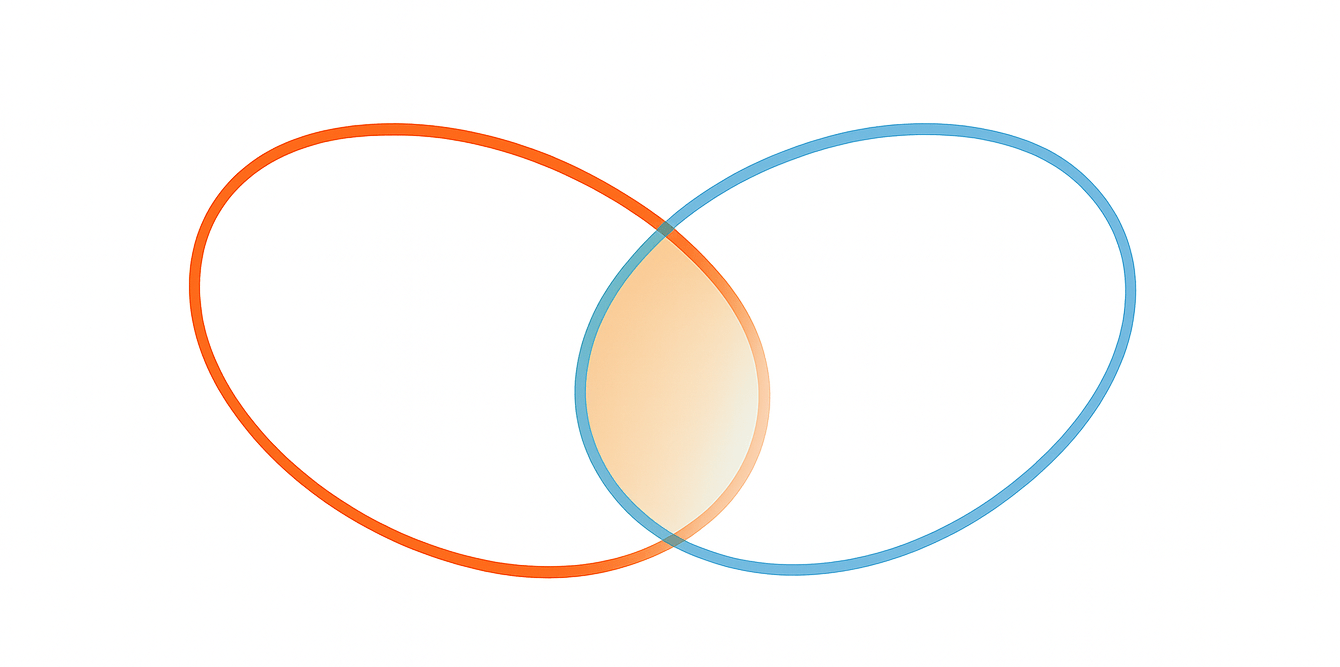
I believe that many concerns over free will have to do with problems of reconciling different perspectives. Indeed, I have come to see the reconciliation of different perspectives as the main underlying problem in most concerns and discussions about free will, even if it is rarely recognized as such.
Contents
- Contrasting Perspectives
- Relevance to Free Will
- Different yet Compatible Perspectives
- The Core Tension: One vs. Multiple Possibilities
- Two Ways to Resolve the Core Tension
- Conclusion
Contrasting Perspectives
The following are some of the contrasting perspectives, or modes of being, that seem relevant to discussions of free will:
- passive vs. active
- descriptive vs. prescriptive
- receptive (e.g. purely observing) vs. creative
- concerned with the actual vs. concerned with the possible
A similar contrast is the one between explanatory versus justificatory reasons and perspectives, such as when we descriptively explain versus normatively justify a given course of action (Alvarez, 2016).
Relevance to Free Will
I see at least three ways in which these contrasting perspectives are relevant to the issue of free will.
First, it seems that many people roughly understand free will as the capacity to adopt and act on the latter perspectives listed above — for example, the capacity to adopt a prescriptive stance that is concerned with realizing some future possibilities over others, and the capacity to take action on that basis. At the very least, these capacities seem to be core components of what many understand by free will (see e.g. Monroe & Malle, 2010; Lam, 2021). To be clear, I am not claiming that this is what everyone understands by free will; the term “free will” is obviously quite ambiguous, and there appears to be substantial variation in how people define it.
Second, in terms of what people take to be the underlying substance of the free will problem, it seems that a key issue for many is whether we can legitimately adopt the latter perspectives above. That is, whether we can legitimately adopt perspectives that are active, prescriptive, creative, and concerned with possibilities, as opposed to only (legitimately) having a passive and actualist perspective.
Third, some thinkers who argue against the existence of free will sometimes seem to speak as though we cannot legitimately adopt these more active and possibility-focused perspectives — as though the passive and actualist perspective is the only legitimate one. To be sure, these thinkers might not hold that view, yet many of their statements can nevertheless easily be interpreted that way, especially by those who see possibility-focused perspectives as being core to “free will” as they understand it.
Different yet Compatible Perspectives
The contrasting perspectives outlined above are surely different, yet they are not in conflict in the sense that we must choose only one of them. Granted, we might not be able to embody the opposing extremes of these perspectives simultaneously, but we can still fruitfully shift between them, and each of these perspectives seems to have its valid uses.
It is also worth noting that the ability to adopt and act on these perspectives can vary in degree. For example, we can develop our capacity to adopt more of a prescriptive stance — e.g. to reflect on our values and to consider the best path going forward. Similarly, we can increase our ability to act from such a values-based stance, thereby increasing our moral agency. Hence, these perspectives and capacities are not simply there or not in some binary sense, and they are not fixed. We can actively cultivate them, and we arguably have good reason to do so.
These points notwithstanding, some may object that there is a fundamental tension to be found in the contrasting perspectives outlined above, and that there are some contrasting perspectives that we cannot legitimately and consistently hold. I will explore this core tension below.
The Core Tension: One vs. Multiple Possibilities
While there are some tensions to be found between each of the general perspectives listed earlier, these tensions are not necessarily so strong and explicit. Where there is a strong tension is when it comes to the following more specific perspectives, or assumptions: (1) assuming that determinism is true, in the sense that there is only one physically possible outcome from any total state of the universe, and (2) assuming that there are multiple possible outcomes that are truly open to us. I believe this is the core tension for many people who are wrestling with the problem of free will.
Some might seek to deflate this tension with the statement that “determinism does not imply fatalism”, meaning that determinism does not imply that we are steered by fate to end up with the same outcome even if we act in different ways. This statement is true, but it does not clearly address the core tension above. If we assume that there is only one total outcome that is physically possible, then this seems inconsistent with at the same time assuming that there are multiple outcomes that are open to us, at least without further clarification. And the latter is an assumption that we seemingly all have to make when we consider and choose between different options — and arguably when we inhabit any broadly “active” perspective.
Of course, one could compartmentalize one’s beliefs and say that we at one level have our purely descriptive and ontological beliefs, while we at another level have our more “active” and decision-related beliefs. If these levels are sufficiently differentiated, one might at the “passive” level believe that there is only one ontologically possible future outcome, yet at the “active” level believe that we have multiple ex-ante possibilities — possibilities that we perceive to be open to us. (These could also be called “epistemic possibilities” or “possibilities in expectation”.)
Something akin to this two-level approach seems common among people who have thought a lot about the subject of free will — both among those who affirm and deny “free will” — even if the two-level approach is only adopted implicitly (see e.g. Harris, 2012, pp. 16, 39; 2013; Dennett, 2014; Tomasik, 2014; Strawson, 2022).
Yet it nevertheless seems rare to see direct and explicit attempts at addressing this core tension — that is, attempts at coherently reconciling a “passive” perspective that may involve one future possibility with an “active” perspective that involves multiple future possibilities. I believe it would be helpful if this core tension were generally addressed more directly by those who discuss the problem of free will.
Two Ways to Resolve the Core Tension
There are at least two ways to resolve the core tension described above: an ontological and an epistemic one. These resolutions are not in conflict — we can consistently endorse both, and they are arguably complementary.
The Ontological Resolution: Total vs. Relative Perspectives
The central move of the ontological resolution is to distinguish two levels at which we can talk about possibilities. Broadly speaking, there is the total level, which pertains to the entire universe, and there is the relative level, which pertains to some subset of the universe.
For example, at the relative level, we may place a boundary around a particular agent and thus partition the world in two: the agent and the world external to that agent, where the agent is concerned with possibilities available in the external world.

The agent in question can be construed in many ways. It could be a small subsystem within a brain, or it could be a large group of individuals with shared aims. How exactly we construe the agent is not important here.
The point of the ontological resolution is that the truth about possibilities can differ depending on whether we are talking about the total or the relative level. In particular, it can both be true that there is one possible outcome at the total level and that there are many possibilities that are truly open to the agent at the relative level, in the sense that the external world fully permits those possibilities.
Note that this resolution does not rely on merely epistemic possibilities: the external world affords genuine possibilities whose realization depends on what the agent does. Indeed, these possibilities are arguably what our epistemic possibilities track to the degree they are well-calibrated. In this sense, we can have genuine ontological possibilities available to us even if the universe is deterministic — that is, fully determined by the external world plus our choices.
This enables the reconciliation of two seemingly opposed perspectives: the universe as a whole can be fully deterministic while we are nevertheless determining actors who choose among genuine possibilities.
The Epistemic Resolution: Uncertainty About Possibilities
The epistemic approach practically reconciles the following contrasting perspectives:
- Unitary openness: There is one possible future at the total level, but agents can still choose among genuine possibilities.
- Plural openness: There are multiple possible futures at the total level, and agents can choose among these possibilities.
Proponents of plural openness might object that unitary openness seems internally inconsistent, despite the distinction between total and relative levels. However, the epistemic resolution does not require us to settle this debate. Instead, it resolves the issue and practically reconciles these perspectives based on our uncertainty. In particular, when it comes to the question of ontological possibilities at the total level, we have reason to assign a non-zero probability both to there being one possible future and to there being multiple possible futures.
This uncertain stance seems to be the most defensible one for the simple reason that we do not know what is true regarding ontological possibilities at the total level, and there are reasons to think that we cannot know (see e.g. Vinding, 2012, ch. 2). There are probably not many who outright deny this uncertainty; the issue is more whether this uncertainty and its potential role in practically reconciling the two views above are explicitly acknowledged.
The uncertain stance is compatible with each of the perspectives outlined above. Proponents of the unitary view may still hold that there is most likely one possible future at the total level, and they would maintain that we can choose among genuine possibilities regardless. Likewise, proponents of the plural view would find no contradiction in this stance of uncertainty: by their lights, the non-zero probability of multiple possible futures at the total level makes it consistent and practically justified to assume that we can choose among genuine possibilities (cf. “Ontological Possibilities and the Meaningfulness of Ethics”).
In short, proponents of these competing views can broadly agree on these key substantive points, including the point that we can legitimately assume genuine possibilities in our decision-making.
Conclusion
Problems relating to free will often appear intractable because we see a strong conflict between different perspectives: the passive view of a cause-and-effect universe and the active view of an agent choosing among multiple possibilities. Yet these perspectives can be reconciled.
Whether we resolve the tension through the ontological distinction between total and relative levels, or through the admission of epistemic uncertainty, the result is the same: we are practically justified in assuming that multiple possibilities are open to us. We need not reject the scientific worldview to legitimate our role as agents. This insight allows us to set aside any paralyzing concern that our choices are somehow illusory and instead focus on using our active and prescriptive capacities to create a better future.
 Magnus Vinding