A virtue-based approach to reducing suffering given long-term cluelessness

This post is a follow-up to my previous essay on reducing suffering given long-term cluelessness. Long-term cluelessness is the idea that we have no clue which actions are likely to create better or worse consequences across the long-term future. In my previous post, I argued that even if we grant long-term cluelessness (a premise I remain skeptical of), we can still steer by purely consequentialist views that do not entail cluelessness and that can ground a focus on effective suffering reduction.

In this post, I will outline an alternative approach centered on virtues. I argue that even if we reject or find no guidance in any consequentialist view, we can still plausibly adopt a virtue-based approach to reducing suffering, including effective suffering reduction. Such an approach can help guide us independently of consequentialist uncertainty.


Contents

  1. What would a virtue-based approach entail?
  2. Justifications for a virtue-based approach
  3. A virtue-based approach to effective suffering reduction
  4. Conclusion

What would a virtue-based approach entail?

It can be difficult to say exactly what a virtue-based approach to reducing suffering would entail. Indeed, an absence of clear and simple rules, and responding wisely in conditions of ambiguity based on good practical judgment, are all typical features of virtue-based approaches in ethics.

That said, in the broadest terms, a virtue-based approach to suffering involves having morally appropriate attitudes, sentiments, thoughts, and behaviors toward suffering. It involves relating to suffering in the way that a morally virtuous person would relate to it.

Perhaps more straightforwardly, we can say what a virtue-based approach would definitely not involve. For example, it would obviously not involve extreme vices like sadism or cruelty, nor would it involve more common yet still serious vices like being indifferent or passive in the face of suffering.

However, a virtue-based approach would not merely involve the morally unambitious aim of avoiding serious vices. It would usually be much more ambitious than that, encouraging us to aim for moral excellence across all aspects of our character — having deep sympathy and compassion, striving to be proactively helpful, having high integrity, and so on.

In this way, a virtue-based approach may invert an intuitive assumption about the implications of cluelessness. That is, rather than seeing cluelessness as a devastating consideration that potentially opens the floodgates to immoral or insensitive behavior, we can instead see it as paving the way for a focus on moral excellence. After all, if no consequentialist reasons count against a strong focus on moral excellence under assumed cluelessness, then arguably the strongest objections against such a focus fall away. As a result, we might no longer have any plausible reason not to pursue moral excellence in our character and conduct. At a minimum, we would no longer have any convenient consequentialist-framed rationalizations for our vices.

Sure, we could retreat to simply being insensitive and disengaged in the face of suffering — or even retreat to much worse vices — but I will argue that those options are less plausible.

Justifications for a virtue-based approach

There are various possible justifications for the approach outlined above. For example, one justification might be that having excellent moral character simply reflects the kind of person we ideally want to be. For some of us, such a personal desire might in itself be a sufficient reason for adopting a virtue-based approach in some form.

Complementary justifications may derive from our moral intuitions. For instance, all else equal, we might find it intuitive that it is morally preferable to embody excellent moral character than to embody serious vices, or that it is more ethical to display basic moral virtues than to lack such virtues (see also Knutsson, 2023, sec. 7.4). (Note that this differs from the justification above in that we need not personally want to be virtuous in order to have the intuition that it is more ethical to be that way.)

We may also find some justification in contractualist considerations or considerations about what kind of society we would like to live in. For example, we may ideally want to live in a society in which people adhere to virtues of compassion and care for suffering, as well as virtues of effectiveness in reducing suffering (more on this in the next section). Under contractualist-style moral frameworks, favoring such a society would in turn give us moral reason to adhere to those virtues ourselves.

A virtue-based approach might likewise find support if we consider specific cases. For example, imagine that you are a powerful war general whose soldiers are committing heinous atrocities that you have the power to stop — with senseless torture occurring on a large scale that you can halt immediately. And imagine that, given your subjective beliefs, your otherwise favored moral views all fail to give any guidance in this situation (e.g. due to uncertainty about long-term consequences). In contrast, ending the torture would obviously be endorsed by any commonsense virtue-based stance, since that is simply what a virtuous, compassionate person would do regardless of long-term uncertainty. If we agree that ending the torture is the morally right response in a case like this, then this arguably lends some support to such a virtue-based stance (as well as to other moral stances that imply the same response).

In general terms, we may endorse a virtue-based approach partly because it provides an additional moral safety net that we can fall back on when other approaches fail. That is, even if we find it most plausible to rely on other views when these provide practical recommendations, we might still find it reasonable to rely on virtue-based approaches in case those other views fall silent. Having virtue ethics as such a supportive layer can help strengthen our foundation and robustness as moral agents.

(One could also attempt to justify a virtue-based approach by appealing to consequentialist reasoning. Indeed, it could be that promoting a non-consequentialist virtue-based stance would ultimately create better consequences than not doing so. For example, the absence of such a virtue-based stance might increase the risk of extremely harmful behavior among moral agents. However, such arguments would involve premises that are not the focus of this post.)

A virtue-based approach to effective suffering reduction

One might wonder whether a virtue-based approach can ground effective suffering reduction of any kind. That is, can a virtue-based approach ground systematic efforts to reduce suffering effectively with our limited resources? In short, yes. If one deems it virtuous to try to reduce suffering in systematic and effective ways (at least in certain decisions or domains), then a virtue-based approach could provide a moral foundation for such efforts.

For instance, if given a choice between saving 10 versus 1,000 chickens from being boiled alive, we may consider it more virtuous — more compassionate and principled — to save the 1,000, even if we had no idea whether that choice ultimately reduces more suffering across all time or across all consequences that we could potentially assess.

To take a more realistic example: in a choice between donating either to a random charity or to a charity with a strong track record of preventing suffering, we might consider it more virtuous to support the latter, even if we do not know the ultimate consequences.

How would such a virtue-based approach be different from a consequentialist approach? Broadly speaking, there can be two kinds of differences. First, a virtue-based approach might differ from a consequentialist one in terms of its practical implications. For instance, in the donation example above, a virtue-based approach might recommend that we donate to the charity with a track record of suffering prevention even if we are unable to say whether it reduces suffering across all time or across all consequences that we could potentially assess.

Second, even if a virtue-based view had all the same practical implications as some consequentialist view, there would still be a difference in the underlying normative grounding or basis of these respective views. The consequentialist view would be grounded purely in the value of consequences, whereas the virtue-based view would not be grounded purely in that (even if the disvalue of suffering may generally be regarded as the most important consideration). Instead, the virtue-based approach would (also) be grounded at least partly in the kind of person it is morally appropriate to be — the kind of person who embodies a principled and judicious compassion, among other virtues (see e.g. the opening summary in Hursthouse & Pettigrove, 2003).

In short, virtue-based views represent a distinctive way in which some version of effective suffering reduction can be grounded.

Conclusion

There are many possible moral foundations for reducing suffering (see e.g. Vinding, 2020, ch. 6; Knutsson & Vinding, 2024, sec. 2). Even if we find one particular foundation to be most plausible by far, we are not forced to rest absolutely everything on such a singular and potentially brittle basis. Instead, we can adopt many complementary foundations and approaches, including an approach centered on excellent moral character that can guide us when other frameworks might fail. I think that is a wiser approach.

Reducing suffering given long-term cluelessness

An objection against trying to reduce suffering is that we cannot predict whether our actions will reduce or increase suffering in the long term. Relatedly, some have argued that we are clueless about the effects that any realistic action would have on total welfare, and this cluelessness, it has been claimed, undermines our reason to help others in effective ways. For example, DiGiovanni (2025) writes: “if my arguments [about cluelessness] hold up, our reason to work on EA causes is undermined.”

There is a grain of truth in these claims: we face enormous uncertainty when trying to reduce suffering on a large scale. Of course, whether we are bound to be completely clueless about the net effects of any action is a much stronger and more controversial claim (and one that I am not convinced of). Yet my goal here is not to discuss the plausibility of this claim. Rather, my goal is to explore the implications if we assume that we are bound to be clueless about whether any given action overall reduces or increases suffering.

In other words, without taking a position on the conditional premise, what would be the practical implications if such cluelessness were unavoidable? Specifically, would this undermine the project of reducing suffering in effective ways? I will argue not. Even if we grant complete cluelessness and thus grant that certain moral views provide no practical recommendations, we can still reasonably give non-zero weight to other moral views that do provide practical recommendations. Indeed, we can find meaningful practical recommendations even if we hold a purely consequentialist view that is exclusively concerned with reducing suffering.


Contents

  1. A potential approach: Giving weight to scope-adjusted views
  2. Asymmetry in practical recommendations
  3. Toy models
  4. Justifications and motivations
    1. Why give weight to multiple views?
    2. Why give weight to a scope-adjusted view?
  5. Arguments I have not made
  6. Conclusion
  7. Acknowledgments

A potential approach: Giving weight to scope-adjusted views

There might be many ways to ground a reasonable focus on effective suffering reduction even if we assume complete cluelessness about long-term consequences. Here, I will merely outline one candidate option, or class of options, that strikes me as fairly reasonable.

As a way to introduce this approach, say that we fully accept consequentialism in some form (notwithstanding various arguments against being a pure consequentialist, e.g. Knutsson, 2023; Vinding, 2023). Yet despite being fully convinced of consequentialism, we are uncertain or divided about which version of consequentialism is most plausible.

In particular, while we give most weight to forms of consequentialism that entail no restrictions or discounts in its scope, we also give some weight to views that entail a more focused scope. (Note that this kind of approach need not be framed in terms of moral uncertainty, which is just one possible way to frame it. An alternative is to think in terms of degrees of acceptance or levels of agreement with these respective views, cf. Knutsson, 2023, sec. 6.6.)

To illustrate with some specific numbers, say that we give 95 percent credence to consequentialism without scope limitations or adjustments of any kind, and 5 percent credence to some form of scope-adjusted consequentialism. The latter view may be construed such that its scope roughly includes those consequences we can realistically estimate and influence without being clueless. This view is similar to what has been called “reasonable consequentialism”, the view that “an action is morally right if and only if it has the best reasonably expected consequences.” It is also similar to versions of consequentialism that are framed in terms of foreseeable or reasonably foreseeable consequences (Sinnott-Armstrong, 2003, sec. 4).

To be clear, the approach I am exploring here is not committed to any particular scope-adjusted view. The deeper point is simply that we can give non-zero weight to one or more scope-adjusted versions of consequentialism, or to scope-adjusted consequentialist components of a broader moral view. Exploring which scope-adjusted view or views might be most plausible is beyond the aims of this essay, and that question arguably warrants deeper exploration.

That being said, I will mostly focus on views centered on (something like) consequences we can realistically assess and be guided by, since something in this ballpark seems like a relatively plausible candidate for scope-adjustment. I acknowledge that there are significant challenges in clarifying the exact nature of this scope, which is likely to remain an open problem subject to continual refinement. After all, the scope of assessable consequences may grow as our knowledge and predictive power grow.

Asymmetry in practical recommendations

The relevance of the approach outlined above becomes apparent when we evaluate the practical recommendations of the clueless versus non-clueless views incorporated in this approach. A completely clueless consequentialist view would give us no recommendations about how to act, whereas a non-clueless scope-adjusted view would give us practical recommendations. (It would do so by construction if its scope includes those consequences we can realistically estimate and influence without being clueless.)

In other words, the resulting matrix of recommendations from those respective views is that the non-clueless view gives us substantive guidance, while the clueless view suggests no alternative and hence has nothing to add to those recommendations. Thus, if we hold something like the 95/5 combined consequentialist view described above — or indeed any non-zero split between these component views — it seems that we have reason to follow the non-clueless view, all things considered.

Toy models

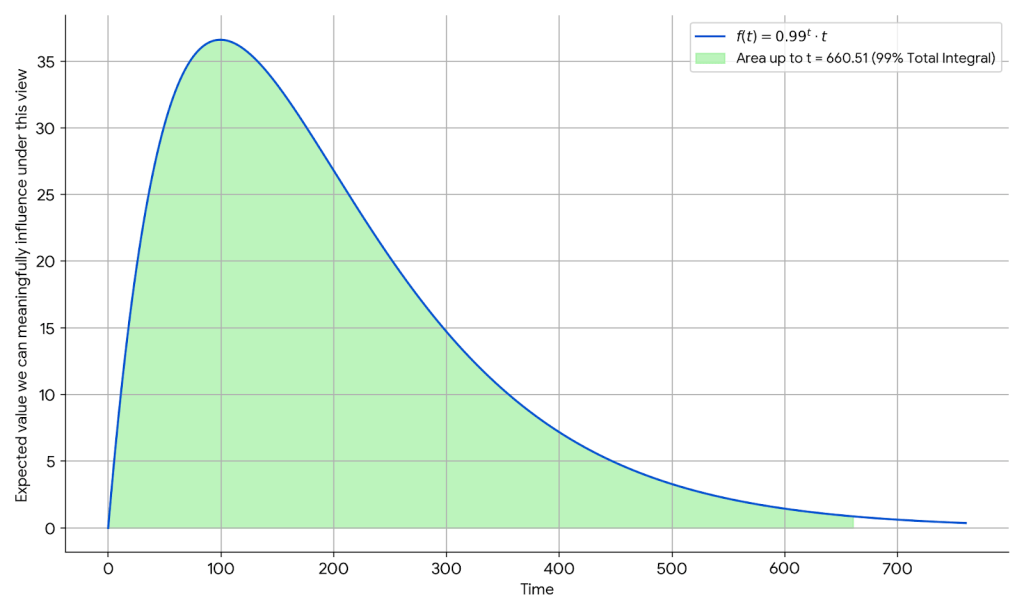
To give a sense of what a scope-adjusted view might look like, we can consider a toy model with an exponential discount factor and an (otherwise) expected linear increase in population size:

The green area represents 99 percent of the total expected value we can influence under this view, implying that almost all the value we can meaningfully influence is found within the next 700 years.

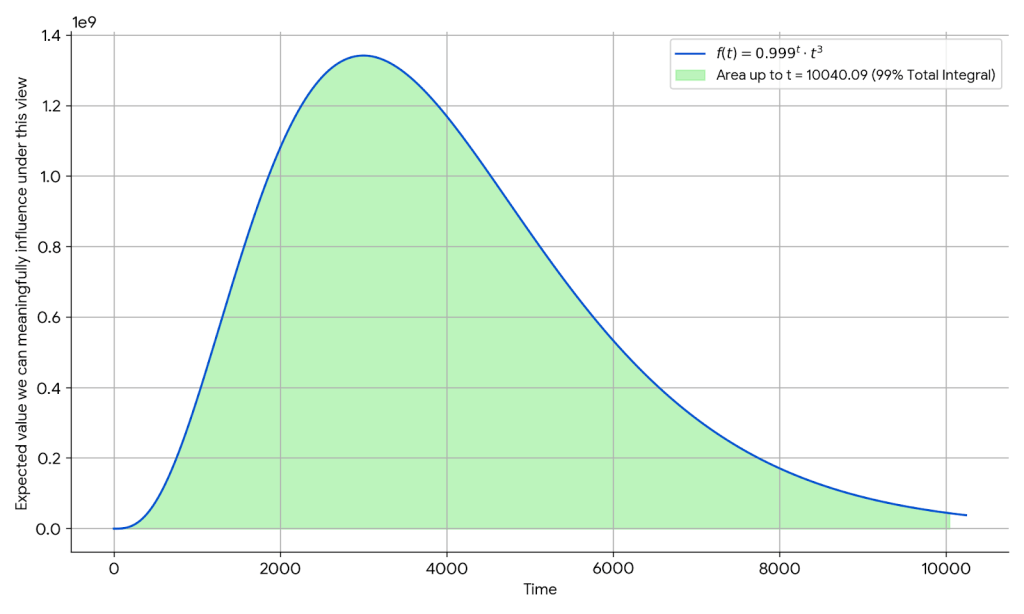
We can also consider a model with a different discount factor and with cubic growth, reflecting the possibility of space expansion radiating from Earth:

On this model, virtually all the expected value we can meaningfully influence is found within the next 10,000 years. In both of the models above, we end up with a sort of de facto “medium-termism”.

Of course, one can vary the parameters in numerous ways and combine multiple models in ways that reflect more sophisticated views of, for example, expected future populations and discount factors. Views that involve temporal discounting allow for much greater variation than what is captured by the toy models above, including views that focus on much shorter or much longer timescales. Moreover, views that involve discounting need not be limited to temporal discounting in particular, or even be phrased in terms of temporal discounting at all. It is one way to incorporate discounting or scope-adjustments, but by no means the only one. 

Furthermore, if we give some plausibility to views that involve discounting of some kind, we need not be committed to a single view for every single domain. We may hold that the best view, or the view we give the greatest weight, will vary depending on the issue at hand (cf. Dancy, 2001; Knutsson, 2023, sec. 3). A reason for such variability may be that the scope of outcomes we can meaningfully predict often differs significantly across domains. For example, there is a stark difference in the predictability of weather systems versus planetary orbits, and similar differences in predictability might be found across various practical and policy-relevant domains.

Note also that a non-clueless scope-adjusted view need not be rigorously formalized; it could, for example, be phrased in terms of our all things considered assessments, which might be informed by myriad formal models, intuitions, considerations, and so on.

Justifications and motivations

What might justify or motivate the basic approach outlined above? This question can be broken into two sub-questions. First, why give weight to more than just a single moral view? Second, provided we give some weight to more than a single view, why give any weight to a scope-adjusted view concerned with consequences?

Why give weight to multiple views?

Reasons for giving weight to more than a single moral view or theory have been explored elsewhere (see e.g. Dancy, 2001; MacAskill et al., 2020, ch. 1; Knutsson, 2023; Vinding, 2023).

One of the reasons that have been given is that no single moral theory seems able to give satisfying answers to all moral questions (Dancy, 2001; Knutsson, 2023). And even if our preferred moral theory appears to be a plausible candidate for answering all moral questions, it is arguably still appropriate to have less than perfect confidence or acceptance in that theory (MacAskill et al., 2020, ch. 1; Vinding, 2023). Such moderation might be grounded in epistemic modesty and humility, a general skepticism toward fanaticism, and the prudence of diversifying one’s bets. It might also be grounded partly in the observation that other thoughtful people hold different moral views and that there is something to be said in favor of those views.

Likewise, giving exclusive weight to a single moral view might make us practically indifferent or paralyzed, whether it be due to cluelessness or due to underspecification as to what our preferred moral theory implies in some real-world situation. Critically, such practical indifference and paralysis may arise even in the face of the most extreme atrocities. If we find this to be an unreasonable practical implication, we arguably have reason not to give exclusive weight to a moral view that potentially implies such paralysis.

Finally, from a perspective that involves degrees of acceptance or agreement with moral views, a reason for giving weight to multiple views might simply be that those moral views each seem intuitively plausible or that we intuitively agree with them to some extent (cf. Knutsson, 2023, sec. 6.6).

Why give weight to a scope-adjusted view?

What reasons could be given for assigning weight to a scope-adjusted view in particular? One reason may be that it seems reasonable to be concerned with consequences to the extent that we can realistically estimate and be guided by them. That is arguably a sensible and intuitive scope for concern about consequences — or at least it appears sensible to some non-zero degree. If we hold this intuition, even if just to a small degree, it seems reasonable to have a final view in which we give some weight to a view focused on realistically assessable consequences (whatever the scope of those consequences ultimately turns out to be).

Some support may also be found in our moral assessments and stances toward local cases of suffering. For example, if we were confronted with an emergency situation in which some individuals were experiencing intense suffering in our immediate vicinity, and if we were readily able to alleviate this suffering, it would seem morally right to help these beings even if we cannot foresee the long-run consequences. (All theoretical and abstract talk aside, I suspect the vast majority of consequentialists would agree with that position in practice.)

Presumably, at least part of what would make such an intervention morally right is the badness of the suffering that we prevent by intervening. And if we hold that it is morally appropriate to intervene to reduce suffering in cases where we can immediately predict the consequences of doing so — namely that we alleviate the suffering right in front of us — it seems plausible to hold that this stance also generalizes to consequences that are less immediate. In other words, if this stance is sound in cases of immediate suffering prevention — or even if it just has some degree of soundness in such cases — it plausibly also has some degree of soundness when it comes to suffering prevention within a broader range of consequences that we can meaningfully estimate and influence.

This is also in line with the view that we have (at least somewhat) greater moral responsibility toward that which occurs within our local sphere of assessable influence. This view is related to, and may be justified in terms of, the “ought implies can” principle. After all, if we are bound to be clueless and unable to deliberately influence very long-run consequences, then, if we accept some version of the “ought implies can” principle, it seems that we cannot have any moral responsibility or moral duties to deliberately shape those long-run consequences — or at least such moral responsibility is plausibly diminished. In contrast, the “ought implies can” principle is perfectly consistent with moral responsibility within the scope of consequences that we realistically can estimate and deliberately influence in a meaningful way.

Thus, if we give some weight to an “ought implies can” conception of moral responsibility, this would seem to support the idea that we have (at least somewhat) greater moral responsibility toward that which occurs within our sphere of assessable influence. An alternative way to phrase it might be to say that our sphere of assessable influence is a special part of the universe for us, in that we are uniquely positioned to predict and steer events in that part compared to elsewhere, and this arguably gives us a (somewhat) special moral responsibility toward that part of the universe.

Another potential reason to give some weight to views centered on realistically assessable consequences, or more generally to views that entail discounting in some form, is that other sensible people endorse such views based on reasons that seem defensible to some degree. For example, it is common for economists to endorse models that involve temporal discounting, not just in descriptive models but also in prescriptive or normative models (see e.g. Arrow et al., 1996). The justifications for such discounting might be that our level of moral concern should be adjusted for uncertainty about whether there will be any future, uncertainty about our ability to deliberately influence the future, and the possibility that the future will be better able to take care of itself and its problems (relative to earlier problems that we could prioritize instead).

One might object that such reasons for discounting should be incorporated at a purely empirical level, without any discounting at the moral level, and I would largely agree with that sentiment. (Note that when applied at a strictly empirical or practical level, those reasons and adjustments are contenders as to how one might avoid paralysis without any discounting at the moral level.)

Yet even if we think such considerations should mostly or almost exclusively be applied at the empirical level, it might still be defensible to also invoke them to justify some measure of discounting directly at the level of one’s moral view and moral concerns, or at least as a tiny sub-component within one’s broader moral view. In other words, it might be defensible to allow empirical considerations of the kind listed above to inform and influence our fundamental moral values, at least to a small degree.

To be clear, it is not just some selection of economists who endorse normative discounting or scope-adjustment in some form. As noted above, it is also found among those who endorse “reasonable consequentialism” and consequentialism framed in terms of foreseeable consequences. And similar views can be found among people who seek to reduce suffering.

For example, Brian Tomasik has long endorsed a kind of split between reducing suffering effectively in the near term versus reducing suffering effectively across all time. In particular, regarding altruistic efforts and donations, he writes that “splitting is rational if you have more than one utility function”, and he devotes at least 40 percent of his resources toward short-term efforts to reduce suffering (Tomasik, 2015). Jesse Clifton seems to partially endorse a similar approach focused on reasons that we can realistically weigh up — an approach that in his view “probably implies restricting attention to near-term consequences” (see also Clifton, 2025). The views endorsed by Tomasik and Clifton explicitly give some degree of special weight to near-term or realistically assessable consequences, and these views and the judgments underlying them seem fairly defensible.

Lastly, it is worth emphasizing just how weak of a claim we are considering here. In particular, in the framework outlined above, all that is required for the simple practical asymmetry argument to go through is that we give any non-zero weight to a non-clueless view focused on realistically assessable consequences, or some other non-clueless view centered on consequences.

That is, we are not talking about accepting this as the most plausible view, or even as a moderately plausible view. Its role in the practical framework above is more that of a humble tiebreaker — a view that we can consult as an nth-best option if other views fail to give us guidance and if we give this kind of view just the slightest weight. And the totality of reasons listed here arguably justify that we grant it at least a tiny degree of plausibility or acceptance.

Arguments I have not made

One could argue that something akin to the approach outlined here would also be optimal for reducing suffering in expectation across all space and time. In particular, one could argue that such an unrestricted moral aim would in practice imply a focus on realistically assessable consequences. I am open to that argument — after all, it is difficult to see what else the recommended focus could be, to the extent there is one.

For similar reasons, one could argue that a practical focus on realistically assessable consequences represents a uniquely safe and reasonable bet from a consequentialist perspective: it is arguably the most plausible candidate for what a consequentialist view would recommend as a practical focus in any case, whether scope-adjusted or not. Thus, from our position of deep uncertainty — including uncertainty about whether we are bound to be clueless — it arguably makes convergent sense to try to estimate the furthest depths of assessable consequences and to seek to act on those estimates, at least to the extent that we are concerned with consequences.

Yet it is worth being clear that the argument I have made here does not rely on any of these claims or arguments. Indeed, it does not rely on any claims about what is optimal for reducing suffering across all space and time.

As suggested above, the conditional claim I have argued for here is ultimately a very weak one about giving minimal weight to what seems like a fairly moderate and in some ways commonsensical moral view or idea (e.g. it seems fairly commonsensical to be concerned with consequences to the extent that we can realistically estimate and be guided by them). The core argument presented in this essay does not require us to accept any controversial empirical positions.

Conclusion

For some of our problems, perhaps the best we can do is to find “second best solutions” — that is, solutions that do not satisfy all our preferred criteria, yet which are nevertheless better than any other realistic solution. This may also be true when it comes to reducing suffering in a potentially infinite universe. We might be in an unpredictable sea of infinite consequences that ripple outward forever (Schwitzgebel, 2024). But even if we are, this need not prevent us from trying to reduce suffering in effective and sensible ways within a realistic scope. After all, compared to simply giving up on trying to reduce suffering, it seems less arbitrary and more plausible to at least try to reduce suffering within the domain of consequences we can realistically assess and be guided by.

Acknowledgments

Thanks to Tobias Baumann, Jesse Clifton, and Simon Knutsson for helpful comments.

A convergence of moral motivations

My aim in this post is to outline a variety of motivations that all point me in broadly the same direction: toward helping others in general and prioritizing the reduction of suffering in particular.


Contents

  1. Why list these motivations?
  2. Clarification
  3. Compassion
  4. Consistency
  5. Common sense: A trivial sacrifice compared to what others might gain
  6. The horror of extreme suffering: The “game over” motivation
  7. Personal identity: I am them
  8. Fairness
  9. Status and recognition
  10. Final reflections

Why list these motivations?

There are a few reasons why I consider it worthwhile to list this variety of moral motivations. For one, I happen to find it interesting to notice that my motivations for helping others are so diverse in their nature. (That might sound like a brag, but note that I am not saying that my motivations are necessarily all that flattering or unselfish.) This diversity in motivations is not obvious a priori, and it also seems different from how moral motivations are often described. For example, reasons to help others are frequently described in terms of a singular motivation, such as compassion.

Beyond mere interest, there may also be some psychological and altruistic benefits to identifying these motivations. For instance, if we realize that our commitment to helping others rests on a wide variety of motivations, this might in turn give us a greater sense that it is a robust commitment that we can be confident in, as opposed to being some brittle commitment that rests on just a single wobbly motivation.

Relatedly, if we have a sense of confidence in our altruistic commitment, and if we are aware that it rests on a broad set of motivations, this might also help strengthen and maintain this commitment. For example, one can speculate that it may be possible to tap into extra reserves of altruistic motivation by skillfully shifting between different sources of such motivation.

Another potential benefit of becoming more aware of, and drawing on, a greater variety of altruistic motivations is that they may each trigger different cognitive styles with their own unique benefits. For example, the patterns of thought and attention that are induced by compassion are likely different from those that are induced by a sense of rigorous impartiality, and these respective patterns might well complement each other.

Lastly, being aware of our altruistic motivations could help give us greater insight into our biases. For example, if we are strongly motivated by empathic concern, we might be biased toward mostly helping cute-looking beings who appeal to our empathy circuits, like kittens and squirrels, and toward downplaying the interests of beings who may look less cute, such as lizards and cockroaches. And note that such a bias can persist even if we are also motivated by impartiality at some level. Indeed, it is a recipe for bias to think that a mere cerebral endorsement of impartiality means that we will thereby adhere to impartiality at every level of our cognition. A better awareness of our moral motivations may help us avoid such naive mistakes.

Clarification

I should clarify that this post is not meant to capture everyone’s moral motivations, nor is my aim to convince people to embrace all the motivations I outline below. Rather, my intention is first and foremost to present the moral motivations that I myself am compelled by, and which all to some extent drive me to try to reduce suffering. That being said, I do suspect that many of these motivations will tend to resonate with others as well.

Compassion

Compassion has been defined as “sympathetic consciousness of others’ distress together with a desire to alleviate it”. This is similar to having empathic concern for others (compassion is often regarded as a component of empathic concern).

In contrast to some of the other motivations listed below, compassion is less cerebral and more directly felt as a motivation for helping others. For example, when we experience sympathy for someone’s misery, we hardly need to go through a sequence of inferences in order to be motivated to alleviate that misery. The motivation to help is almost baked into the sympathy itself. Indeed, studies suggest that empathic concern is a significant driver of costly altruism.

In my own case, I think compassion tends to play an important role, though I would not claim that it is sufficient or even necessary for motivating the general approach that I would endorse when it comes to helping others. One reason it is not sufficient is that it needs to be coupled with a more systematic component, which I would broadly refer to as ‘consistency’.

Consistency

As a motivation for helping others, consistency is rather different from compassion. For example, unlike compassion, consistency is cerebral in nature, to the degree that it almost has a logical or deductive character. That is, unlike compassion, consistency per se does not highlight others’ suffering or welfare from the outset. Instead, efforts to help others are more a consequence of applying consistency to our knowledge about our own direct experience: I know that intense suffering feels bad and is worth avoiding for me (all else equal), and hence, by consistency, I conclude that intense suffering feels bad and is worth avoiding for everyone (all else equal).

One might object that it is not inconsistent to view one’s own suffering as being different from the suffering of others, such as by arguing that there are relevant differences between one’s own suffering and the suffering of others. I think there are several points to discuss back and forth on this issue. However, I will not engage in such arguments here, since my aim in this section is not to defend consistency as a moral motivation, but simply to present a rough outline as to how consistency can motivate efforts to help others.

As noted above, a consistency-based motivation for helping others does not strictly require compassion. However, in psychological terms, since none of us are natural consistency-maximizers, it seems likely that compassion will usually be helpful for getting altruistic motivations off the ground in practice. Conversely, as hinted in the previous section, compassion alone is not sufficient for motivating the most effective actions for helping others. After all, one can have a strong desire to reduce suffering without having the consistency-based motivation to treat equal suffering equally and to spend one’s limited resources accordingly.

In short, the respective motivations of compassion and consistency seem to each have unique benefits that make them worth combining, and I would say that they are both core pillars in my own motivations for helping others.

Common sense: A trivial sacrifice compared to what others might gain

Another motivation that appeals to me might be described as a commonsense motivation. That is, there is a vast number of sentient beings in the world, of which I am just one, and hence the beneficial impact that I can have on other sentient beings is vastly greater than the beneficial impact I can have on my own life. After all, once my own basic needs are met, there is probably little I can do to improve my wellbeing much further. Indeed, I will likely find it more meaningful and fulfilling to try to help others than to try to improve my own happiness (cf. the paradox of hedonism and the psychological benefits of having a prosocial purpose).

Of course, it is difficult to quantify just how much greater our impact on others might be compared to our impact on ourselves. Yet given the enormous number of sentient beings who exist around us, and given that our impact potentially reaches far into the future, it is not unreasonable to think that it could be greater by at least a factor of a million (e.g. we may prevent at least million times as many instances of similarly bad suffering in expectation for others than for ourselves).

In light of this massive difference in potential impact, it feels like a no-brainer to dedicate a significant amount of resources toward helping others, especially when my own basic needs are already met. Not doing so would amount to giving several orders of magnitude greater importance to my own wellbeing than to the wellbeing of others, and I see no justification for that. Indeed, one need not endorse anything close to perfect consistency and impartiality to believe that such a massively skewed valuation is implausible. It is arguably just common sense.

The horror of extreme suffering: The “game over” motivation

A particularly strong motivation for me is the sheer horror of extreme suffering. I refer to this as the “game over” motivation because that is my reaction when I witness cases of extreme suffering: a clear sense that nothing is more important than the prevention of such extreme horrors. Game over.

One might argue that this motivation is not distinct from compassion and empathic concern in the broadest sense. And I would agree that it is a species of that broad category of motivations. But I also think there is something distinctive about this “game over” motivation compared to generic empathic concern. For example, the “game over” motivation seems meaningfully different from the motivation to help someone who is struggling in more ordinary ways. In fact, I think there is a sense in which our common circuitry of sympathetic relating practically breaks down when it comes to extreme suffering. The suffering becomes so extreme and unthinkable that our “sympathometer” crashes, and we in effect check out. This is another reason it seems accurate to describe it as a “game over” motivation.

Where the motivations listed above all serve to motivate efforts to help others in general, the motivation described in this section is more of a driver as to what, specifically, I consider the highest priority when it comes to helping others, namely to alleviate and prevent extreme suffering.

Personal identity: I am them

Another motivation derives from what may be called a universal view of personal identity, also known as open individualism. This view entails that all sentient beings are essentially different versions of you, and that there is no deep sense in which the future consciousness-moments of your future self (in the usual narrow sense) is more ‘you’ than the future consciousness-moments of other beings.

Again, I will not try to defend this view here, as opposed to just describing how it can motivate efforts to help others (for a defense, see e.g. Kolak, 2004; Leighton, 2011, ch. 7; Vinding, 2017).

I happen to accept this view of personal identity, and in my opinion it ultimately leaves no alternative but to work for the benefit of all sentient beings. In light of open individualism, it makes no more sense to endorse narrow egoism than to, say, only care about one’s own suffering on Tuesdays. Both equally amount to an arbitrary disregard of my own suffering from an open individualist perspective.

This is one of the ways in which my motivations for helping others are not necessarily all that flattering: on a psychological level, I often feel that I am selfishly trying to prevent future versions of myself from being tortured, virtually none of whom will share my name.

I would say that the “I am them” motivation is generally a strong driver for me, not in a way that changes any of the basic upshots derived from the other motivations, but in a way that reinforces them.

Fairness

Considerations and intuitions related to fairness are also motivating to me. For example, I am lucky to have been born in a relatively wealthy country, and not least to have been born as a human rather than as a tightly confined chicken in a factory farm or a preyed-upon mouse in the wild. There is no sense in which I personally deserve this luck over those who are born in conditions of extreme misery and destitution. Consequently, it is only fair that I “pay back” my relative luck by working to help those beings who were or will be much less lucky in terms of their birth conditions and the like.

I should note that this is not among my stronger or more salient motivations, but I still think it has significant appeal and that it plays some role for me.

Status and recognition

Lastly, I want to highlight the motivation that any cynic would rightly emphasize, namely to gain status and recognition. Helping others can be a way to gain recognition and esteem among our peers, and I am obviously also motivated by that.

There is quite a taboo around acknowledging this motive, but I think that is a mistake. It is simply a fact about the human mind that we want recognition, and this is not necessarily a problem in and of itself. It only becomes a problem if we allow our drive for status to corrupt our efforts to help others, which is no doubt a real risk. Yet we hardly reduce that risk by pretending that we are unaffected by these drives. On the contrary, openly admitting our status motives probably gives us a better chance of mitigating their potentially corrupting influence.

Moreover, while our status drives can impede our altruistic efforts, we should not overlook the possibility that they might sometimes do the opposite, namely improve our efforts to help others.

How could that realistically happen? One way it might happen is by forcing us to seek out the assessments of informed people. That is, if our altruistic efforts are partly driven by a motive to impress relevant experts and evaluators of our work, we might be more motivated to consider and integrate a wider range of informed perspectives (compared to if we were not motivated to impress such evaluators).

Of course, this only works if we are indeed motivated to impress an informed audience, as opposed to just any audience that may be eager to throw recognition after us. Seeking the right audience to impress — those who are impressed by genuinely helpful contributions — might thus be key to making our status drives work in favor of our altruistic efforts rather than against them (cf. Hanson, 2010; 2018). 

Another reason to believe that status drives can be helpful is that they have proven to be psychologically potent for human beings. Hence, if we could hypothetically rob a human brain of its status drives, we might well reduce its altruistic drives overall, even if other sources of altruistic motivation were kept intact. It might be tantamount to removing a critical part of an engine, or at least a part that adds a significant boost.

In terms of my own motivations, I would say that drives for status probably often do help motivate my altruistic efforts, whether I endorse my status drives or not. Yet it is difficult to estimate the strength and influence of these drives. After all, the status motive is regarded as unflattering, and hence there are reasons to think that my mind systematically downplays its influence. Moreover, like all of the motivations listed here, the status motive likely varies in strength depending on contextual factors, such as whether I am around other people or not; I suspect that it becomes weaker when I am more isolated, which in effect suggests a way to reduce my status drives when needed.

I should also note that I aspire to view my status drives with extreme suspicion. Despite my claims about how status drives could potentially be helpful, I think the default — if we do not make an intense effort to hone and properly direct our status drives — is that they distort our efforts to help others. And I think the endeavor of questioning our status drives tends to be extremely difficult, not least since status-seeking behavior can take myriad forms that do not look or feel anything like status-seeking behavior. It might just look like “conforming to the obviously reasonable views of my peers”, or like “pursuing this obscure and interesting idea that somehow feels very important”.

So a key question I try to ask myself is: am I really trying to help sentient beings, or am I mostly trying to raise my personal status? And I strive to look at my professed answers with skepticism. Fortunately, I feel that the “I am them” motivation can be a powerful tool in this regard. It essentially forces the selfish parts of my mind to ask: do I really want to gain status more than I want to prevent my future self from being tortured? If not, then I have strong reasons to try to reduce any torture-increasing inefficiencies that might be introduced by my status motives, and to try, if possible, to harness my status motives in the direction of reducing my future torment.

Final reflections

The motivations described above make up quite a complicated mix, from other-oriented compassion and fairness to what feels more like a self-oriented motivation aimed at sparing myself (in an expansive sense) from extreme suffering. I find it striking just how diverse these motivations are, and how they nonetheless — from so seemingly different starting points — can end up converging toward roughly the same goal: to reduce suffering for all sentient beings.

For me, this convergence makes the motivation to help others feel akin to a rope that is weaved from many complementary materials: even if one of the strings is occasionally weakened, the others can usually still hold the rope together.

But again, it is worth stressing that the drive for status is somewhat of an exception, in that it takes serious effort to make this drive converge toward aims that truly help other sentient beings. More generally, I think it is important to never be complacent about the potential for our status drives to corrupt our motivations to help others, even if we feel like we are driven by a strong and diverse set of altruistic motivations. Status drives are like the One Ring: powerful yet easily corrupting, and they are probably best viewed as such.

Suffering-Focused Ethics: Defense and Implications

The reduction of suffering deserves special priority. Many ethical views support this claim, yet so far these have not been presented in a single place. Suffering-Focused Ethics provides the most comprehensive presentation of suffering-focused arguments and views to date, including a moral realist case for minimizing extreme suffering. The book then explores the all-important issue of how we can best reduce suffering in practice, and outlines a coherent and pragmatic path forward.

Amazon (Kindle, paperback, and hardcover)
Apple Books, Barnes & Noble, Kobo, Scribd, Vivlio, 24symbols, Angus & Robertson
Smashwords
Paperback PDF
Audible/Amazon (audiobook)

Suffering-Focused Ethics - 3D


“An inspiring book on the world’s most important issue. Magnus Vinding makes a compelling case for suffering-focused ethics. Highly recommended.”
— David Pearce, author of The Hedonistic Imperative and Can Biotechnology Abolish Suffering?

“We live in a haze, oblivious to the tremendous moral reality around us. I know of no philosopher who makes the case more resoundingly than Magnus Vinding. In radiantly clear and honest prose, he demonstrates the overwhelming ethical priority of preventing suffering. Among the book’s many powerful arguments, I would call attention to its examination of the overlapping biases that perpetuate moral unawareness. Suffering-Focused Ethics will change its readers, opening new moral and intellectual vistas. This could be the most important book you will ever read.
Jamie Mayerfeld, professor of political science at the University of Washington, author of Suffering and Moral Responsibility and The Promise of Human Rights

“In this important undertaking, Magnus Vinding methodically and convincingly argues for the overwhelming ethical importance of preventing and reducing suffering, especially of the most intense kind, and also shows the compatibility of this view with various mainstream ethical philosophies that don’t uniquely focus on suffering. His careful analytical style and comprehensive review of existing arguments make this book valuable reading for anyone who cares about what matters, or who wishes to better understand the strong rational underpinning of suffering-focused ethics.”
— Jonathan Leighton, founder of the Organisation for the Prevention of Intense Suffering, author of The Battle for Compassion: Ethics in an Apathetic Universe

“Magnus Vinding breaks the taboo: Today, the problem of suffering is the elephant in the room, because it is at the same time the most relevant and the most neglected topic at the logical interface between applied ethics, cognitive science, and the current philosophy of mind and consciousness. Nobody wants to go there. It is not good for your academic career. Only few of us have the intellectual honesty, the mental stamina, the philosophical sincerity, and the ethical earnestness to gaze into the abyss. After all, it might also gaze back into us. Magnus Vinding has what it takes. If you are looking for an entry point into the ethical landscape, if you are ready to face the philosophical relevance of extreme suffering, then this book is for you. It gives you all the information and the conceptual tools you need to develop your own approach. But are you ready?”
Thomas Metzinger, professor of philosophy at the Johannes Gutenberg University of Mainz, author of Being No One and The Ego Tunnel

Narrative Self-Deception: The Ultimate Elephant in the Brain?

the elephant in the brain, n. An important but un­ack­now­ledged fea­ture of how our minds work; an introspective taboo.”

The Elephant in the Brain is an informative and well-written book, co-authored by Kevin Simler and Robin Hanson. It explains why much of our behavior is driven by unflattering, hidden motives, as well as why our minds are built to be unaware of these motives. In short: because a mind that is ignorant about what drives it and how it works is often more capable of achieving the aims that it was built to achieve.

The book also seeks to apply this knowledge, to shed some light on the hidden motives of many of our social institution. Rather than being about high-minded ideals, our institutions often serve much less pretty, more status-driven purposes, such as showing off in various ways, as well as to help us better get by in a tough world.

All in all, I think The Elephant in the Brain provides a strong case for supplementing one’s mental toolkit with a new, important tool, namely to continuously ask: How might my mind skillfully be avoiding confrontation with ugly truths about myself that I would prefer not to face? And how might such unflattering truths explain aspects of our public institutions and public life in general?

This is an important lesson, I think, and it makes the book more than worth reading. At the same time, I cannot help but feel that the book ultimately falls short when it comes to putting this tool to proper use. For the main critique that came to my mind while reading the book was that it seemed to ignore the biggest elephant in the brain by far — the elephant I suspect we would all prefer to ignore the most — and hence it failed, in my view, to take a truly deep and courageous look at the human condition. In fact, the book even seemed be a mouthpiece for this great elephant.

The great elephant I have in mind here is a tacitly embraced sentiment that goes something like: life is great, and we are accomplishing something worthwhile. As the authors write “life, for must of us, is pretty good”, and they end the book on a similar note:

In the end, our motives were less important than what we managed to achieve by them. We may be competitive social animals, self-interested and self-deceived, but we cooperated our way to the god-damned moon.

This seems to implicitly assume that what humans have managed to achieve, such as cooperating (i.e. two superpowers with nuclear weapons pointed at each other competing) their way to the moon, has been worthwhile all things considered. Might this, however, be a flippant elephant talking, rather than, say, a conclusion derived via a serious analysis of our condition?

The fact that people often get offended and become defensive when one even just questions the value of our condition — and sometimes also accuse the one raising the question of having a mental illness — suggests that we may indeed be disturbing a great elephant here; something we would strongly prefer not to think too deeply about.

It is important to note here that one should not confuse the cynicism required for honest exploration of the human condition with misanthropy, as Simler and Hanson themselves are careful to point out:

The line between cynicism and misanthropy—between thinking ill of human motives and thinking ill of humans—is often blurry. So we want readers to understand that although we may often be skeptical of human motives, we love human beings. (Indeed, many of our best friends are human!) […] All in all, we doubt an honest exploration will detract much from our affection for [humans]. (p. 13)

Similarly, an honest and hard-nosed effort to assess the value of human life and the human endeavor need not lead us to have less compassion for humans. Indeed, it might lead us to have much more compassion for each other.

Is Life “Pretty Good”?

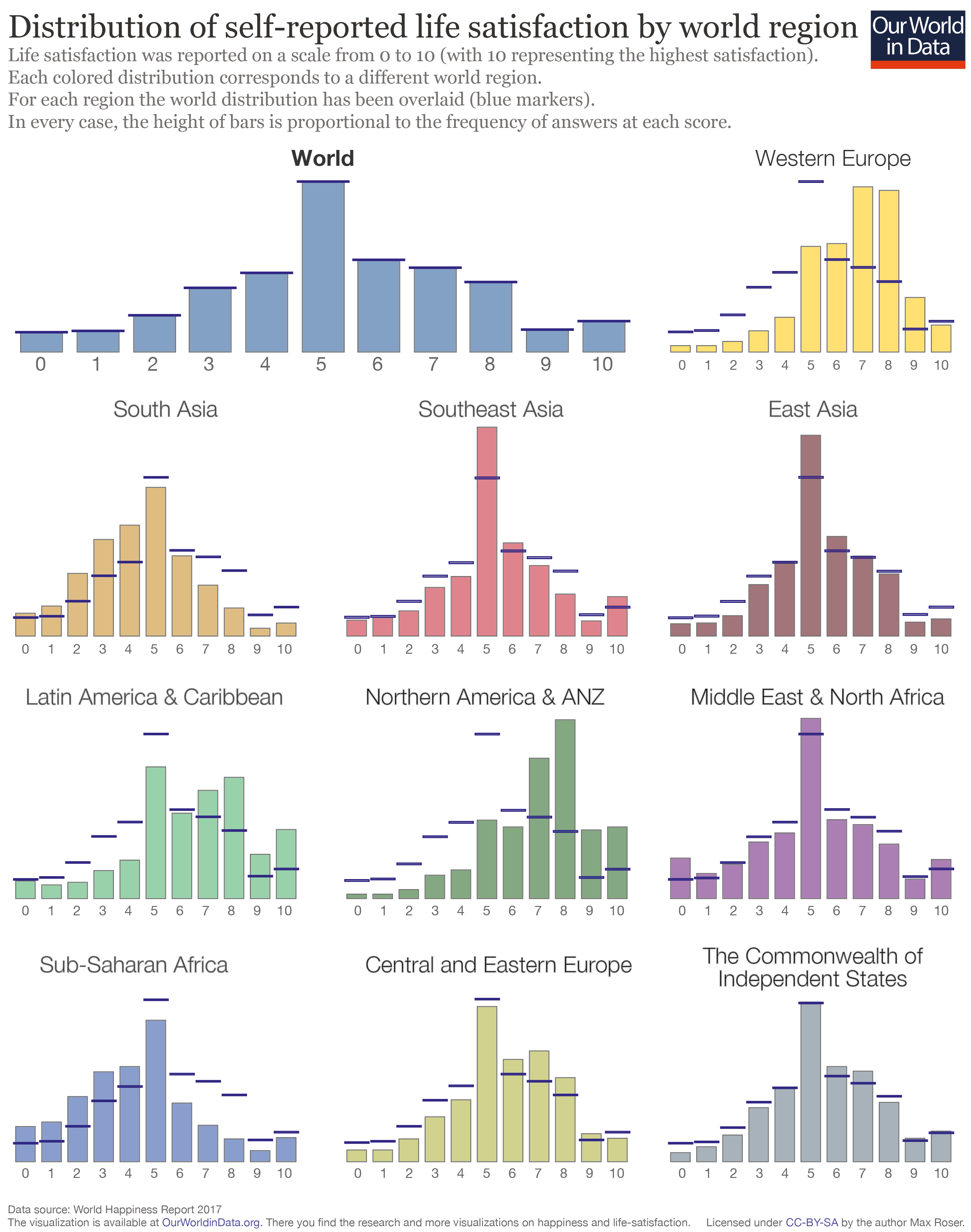
With respect to Simler and Hanson’s claim that “life, for must of us, is pretty good”, it can be disputed whether this is indeed the case. According to the 2017 World Happiness Report, most people rated their life satisfaction at five or below on a scale from zero to ten, which arguably does not translate to being “pretty good”. Indeed, one can argue that the scale employed in this report is biased, in that it does not allow for a negative evaluation of life.

But even if we were to concede that most people say that their lives are pretty good, one can still reasonably question whether most people’s lives indeed are pretty good, and not least question whether such reports imply that the human condition is worthwhile in a broader sense.

Narrative Self-Deception: Is Life As Good As We Think?

Just as it is possible for us to be wrong about our own motives, as Simler and Hanson convincingly argue, could it be that we can also be wrong about how good our lives are? Furthermore, could it be that we not only can be wrong but that most of us in fact are wrong about it most of the time? This is indeed what some philosophers argue, seemingly supported by psychological evidence.

One philosopher who has argued along these lines is Thomas Metzinger. In his essay “Suffering“, Metzinger reports on a pilot study he conducted in which students were asked at random times via their cell phones whether they would relive the experience they had just before their phone vibrated. The results were that, on average, students reported that their experience was not worth reliving 72 percent of the time. Metzinger uses this data, which he admits does not count as significant, as a starting point for a discussion on how our narrative about the quality of our lives might be out of touch with the reality of our felt, moment-to-moment experience:

If, on the finest introspective level of phenomenological granularity that is functionally available to it, a self-conscious system would discover too many negatively valenced moments, then this discovery might paralyse it and prevent it from procreating. If the human organism would not repeat most individual conscious moments if it had any choice, then the logic of psychological evolution mandates concealment of the fact from the self-modelling system caught on the hedonic treadmill. It would be an advantage if insights into the deep structure of its own mind – insights of the type just sketched – were not reflected in its conscious self-model too strongly, and if it suffered from a robust version of optimism bias. Perhaps it is exactly the main function of the human self-model’s higher levels to drive the organism continuously forward, to generate a functionally adequate form of self-deception glossing over everyday life’s ugly details by developing a grandiose and unrealistically optimistic inner story – a “narrative self-model” with which we can identify?

Metzinger continues to conjecture that we might be subject to what he calls “narrative self-deception” — a self-distracting strategy that keeps us from getting a realistic view of the quality and prospects of our lives:

a strategy of flexible, dynamic self­-representation across a hierarchy of timescales could have a causal effect in continuously remotivating the self-­conscious organism, systematically distracting it from the potential insight that the life of an anti-­entropic system is one big uphill battle, a strenuous affair with minimal prospect of enduring success. Let us call this speculative hypothesis “narrative self­-deception”.

If this holds true, such self-deception would seem to more than satisfy the definition of an elephant in the brain in Simler and Hanson’s sense: “an important but un­ack­now­ledged fea­ture of how our minds work; an introspective taboo.”

To paraphrase Metzinger: the mere fact that we find life to be “pretty good” when we evaluate it from the vantage point of a single moment does not mean that we in fact find most of our experiences “pretty good”, or indeed even worth (re)living most of the time, moment-to-moment. Our single-moment evaluations of the quality of the whole thing may well tend to be gross, self-deceived overestimates. And recent studies suggest that this is indeed the case.

Another philosopher who makes a similar case is David Benatar, who in his book Better Never to Have Been argues that we tend to overestimate the quality of our lives due to well-documented psychological biases:

The first, most general and most influential of these psychological phenomena is what some have called the Pollyanna Principle, a tendency towards optimism. This manifests in many ways. First, there is an inclination to recall positive rather than negative experiences. For example, when asked to recall events from throughout their lives, subjects in a number of studies listed a much greater number of positive than negative experiences. This selective recall distorts our judgement of how well our lives have gone so far. It is not only assessments of our past that are biased, but also our projections or expectations about the future. We tend to have an exaggerated view of how good things will be. The Pollyannaism typical of recall and projection is also characteristic of subjective judgements about current and overall well-being. Many studies have consistently shown that self-assessments of well-being are markedly skewed toward the positive end of the spectrum.

Is “Pretty Good” Good Enough?

Beyond doubting whether most people would say that their lives are “pretty good”, and beyond doubting that a single moment’s assessment of one’s quality of life actually reflects this quality all that well, one can also question whether a life that is rated as “pretty good”, even in the vast majority of moments, is indeed good enough to render it worth starting for its own sake.

This is, for example, not necessarily the case on tranquilist or antifrustrationist views of value, according to which experiential wellbeing consists of the absence of suffering or preference frustrations. Similar to Metzinger’s point about narrative self-deception, one can argue that, if tranquilist or antifrustrationist views happen to be plausible views of the value of our experiences (upon closer inspection), we should probably expect to be quite blind or resistant to this fact. And interesting to note in this context is that many of the traditions that have placed a strong emphasis on paying attention to our direct experience, including some strands of Buddhism, seem to have converged on views very similar to tranquilism and antifrustrationism.

Can the Good Lives Outweigh the Bad?

One can also question the value of our condition on a more collective level, by focusing not only on a single (self-reportedly) “pretty good” life, but on all individual lives. In particular, we can question whether the good lives of some can justify the miserable lives of others.

A story that gives many people pause on this question is Ursula K. Le Guin’s The Ones Who Walk Away from Omelas. The story is about a near-paradisiacal city in which everyone lives deeply meaningful and fulfilling lives — that is, everyone except a single child who is locked in a basement room, forced to live a life of squalor:

The child used to scream for help at night, and cry a good deal, but now it only makes a kind of whining, “eh-haa, eh-haa,” and it speaks less and less often. It is so thin there are no calves to its legs; its belly protrudes; it lives on a half-bowl of corn meal and grease a day. It is naked. Its buttocks and thighs are a mass of festered sores, as it sits in its own excrement continually.

The story’s premise is that this child must exist in this condition for the happy people of Omelas to enjoy their lives, which then raises the question of whether the enjoyment found in these lives can morally outweigh and justify the misery of this single child. Some citizens of Omelas seem to decide that this is not the case: the ones who walk away from Omelas.

Sadly, our world is much worse than the city of Omelas on every measure. For example, in the World Happiness Report cited above, around 200 million people reported their quality of life to be in the absolute worst category. If the story of Omelas gives us pause, we should also think twice before claiming that the “pretty good” lives of some people can outweigh the self-reportedly very bad lives of these hundreds of millions of people, many of whom decide to end their own lives by suicide.

Beyond that, one can question whether the “pretty good” lives of some humans can in any sense outweigh or justify the enormous amount of suffering humanity that imposes on non-human animals, including the torturous suffering we impose on more than a trillion fish each year, as well as the suffering that we impose upon the tens of billions of chickens and turkeys who live out their lives under the horrific conditions of factory farming, many of whom end their lives by being boiled alive.

My aim in this essay has not been to draw any conclusions about the value of our condition. Rather, my aim has been to argue that we likely have an elephant in our brain that leads us to evaluate our lives, individually as well as collectively, in overoptimistic terms, and to ignore the many considerations that might suggest a negative conclusion. This is an elephant that pushes us toward the conclusion that “it’s all pretty good and worthwhile”, and which disposes us to flinch away from serious, sober-minded engagement with questions concerning the value of our condition, including whether it would be better if there had been no sentient beings at all.

The Principle of Sympathy for Intense Suffering

This essay was first published as a chapter in my book Effective Altruism: How Can We Best Help Others? which is available for free download here. The chapter that precedes it makes a general case for suffering-focused ethics, whereas this chapter argues for a particular suffering-focused view. A more elaborate case for suffering-focused ethics can be found in my book Suffering-Focused Ethics: Defense and Implications.


The ethical view I would advocate most strongly is a suffering-focused view that centers on a core principle of Sympathy for Intense Suffering, or SIS for short, which roughly holds that we should prioritize the interests of those who are, or will be, in a state of extreme suffering. In particular: that we should prioritize their interest in avoiding such suffering higher than anything else.[1]

One can say that this view takes its point of departure in classical utilitarianism, the theory that we should maximize the net sum of happiness minus suffering. Yet it questions a tacit assumption, a particular existence claim, often held in conjunction with the classical utilitarian framework, namely that for every instance of suffering, there exists some amount of happiness that can outweigh it.

This is a deeply problematic assumption, in my view. More than that, it is peculiar that classical utilitarianism seems widely believed to entail this assumption, given that (to my knowledge) none of the seminal classical utilitarians — Jeremy Bentham, John Stuart Mill, and Henry Sidgwick — ever argued for this existence claim, or even discussed it.[2] Thus, it seems that the acceptance of this assumption is no more entailed by classical utilitarianism, defined as the ethical view, or views, expressed by these utilitarian philosophers, than is its rejection.

The question of whether this assumption is reasonable ties into a deeper discussion about how to measure and weigh happiness and suffering against each other, and I think this is much less well-defined than is commonly supposed (even though the trickiness of the task is often acknowledged).[3] The problem is that we have a common sense view that goes something like the following: if a conscious subject deems some state of suffering worth experiencing in order to attain some given pleasure, then this pleasure is worth the suffering. And this common sense view may work for most of us most of the time.[4] Yet it runs into problems in cases where the subject deems their suffering so unbearable that no amount of happiness could ever outweigh it.

For what would the common sense view say in such a situation? That the suffering indeed cannot be outweighed by any pleasure? That would seem an intuitive suggestion, yet the problem is that we can also imagine the case of an experience of some pleasure that the subject, in that experience-moment, deems so great that it can outweigh even the worst forms of suffering, which leaves us with mutually incompatible value claims (although it is worth noting that one can reasonably doubt the existence of such positive states, whereas, as we shall see below, the existence of correspondingly negative experiences is a certainty).[5] How are we to evaluate these claims?

The aforementioned common sense method of evaluation has clearly broken down at this point, and is entirely silent on the matter. We are forced to appeal to another principle of evaluation. And the principle I would argue we should employ is, as hinted above, to choose to sympathize with those who are worst off — those who are experiencing intense suffering. Hence the principle of sympathy for intense suffering: we should sympathize with, and prioritize, the evaluations of those subjects who deem their suffering unoutweighable, even if only for a brief experience-moment, and thus give total priority to helping these subjects. More precisely, we should minimize the amount of such experience-moments of extreme suffering.[6] That, on this account of value, is the greatest help we can do for others.

This principle actually seems to have a lot of support from common sense and “common wisdom”. For example, imagine two children are offered to ride a roller coaster, one of whom would find the ride very pleasant, while the other child would find it very unpleasant, and imagine, furthermore, that the only two options available are that they either both ride or neither of them ride (and if neither of them ride, they are both perfectly fine).[7] Whose interests should we sympathize with and favor? Common sense would appear to favor the child who would not want to take the ride. The mere pleasure of the “ride-positive” child does not justify a violation of the interest of the other child not to suffer a very unpleasant experience. The interest in not enduring such suffering seems far more fundamental, and hence to have ethical primacy, compared to the relatively trivial and frivolous interest of having a very pleasant experience.[8]

Arguably, common sense even suggests the same in the case where there are many more children who would find the ride very pleasant, while still only one child who would find it very unpleasant (provided, again, that the children will all be perfectly fine if they do not ride). Indeed, I believe a significant fraction of people would say the same no matter how many such “ride-positive” children we put on the scale: it would still be wrong to give them the ride at the cost of forcing the “ride-negative” child to undergo the very unpleasant experience.[9]

And yet the suffering in this example — a very unpleasant experience on a roller coaster — can hardly be said to count as remotely extreme, much less an instance of the worst forms of suffering; the forms of suffering that constitute the strongest, and in my view overwhelming, case for the principle of sympathy for intense suffering. Such intense suffering, even if balanced against the most intense forms of pleasure imaginable, only demands even stronger relative sympathy and priority. However bad we may consider the imposition of a very unpleasant experience for the sake of a very pleasant one, the imposition of extreme suffering for the sake of extreme pleasure must be deemed far worse.

The Horrendous Support for SIS

The worst forms of suffering are so terrible that merely thinking about them for a brief moment can leave the average sympathetic person in a state of horror and darkness for a good while, and therefore, quite naturally, we strongly prefer not to contemplate these things. Yet if we are to make sure that we have our priorities right, and that our views about what matters most in this world are as well-considered as possible, then we cannot shy away from the task of contemplating and trying to appreciate the disvalue of these worst of horrors. This is no easy task, and not just because we are reluctant to think about the issue in the first place, but also because it is difficult to gain anything close to a true appreciation of the reality in question. As David Pearce put it:

It’s easy to convince oneself that things can’t really be that bad, that the horror invoked is being overblown, that what is going on elsewhere in space-time is somehow less real than this here-and-now, or that the good in the world somehow offsets the bad. Yet however vividly one thinks one can imagine what agony, torture or suicidal despair must be like, the reality is inconceivably worse. Hazy images of Orwell’s ‘Room 101’ barely hint at what I’m talking about. The force of ‘inconceivably’ is itself largely inconceivable here.[10]

Nonetheless, we can still gain at least some, admittedly rather limited, appreciation by considering some real-world examples of extreme suffering (what follows are examples of an extremely unpleasant character that may be triggering and traumatizing).

One such example is the tragic fate of the Japanese girl Junko Furuta who was kidnapped in 1988, at the age of 16, by four teenage boys. According to their own trial statements, the boys raped her hundreds of times; “inserted foreign objects, such as iron bars, scissors and skewers into her vagina and anus, rendering her unable to defecate and urinate properly”; “beat her several times with golf clubs, bamboo sticks and iron rods”; “used her as a punching bag by hanging her body from the ceiling”; “dropped barbells onto her stomach several times”; “set fireworks into her anus, vagina, mouth and ear”; “burnt her vagina and clitoris with cigarettes and lighters”; “tore off her left nipple with pliers”; and more. Eventually, she was no longer able to move from the ground, and she repeatedly begged the boys to kill her, which they eventually did, after 44 days.[11]

An example of extreme suffering that is much more common, indeed something that happens countless times every single day, is being eaten alive, a process that can sometimes last several hours with the victim still fully conscious of being devoured, muscle by muscle, organ by organ. A harrowing example of such a death that was caught on camera (see the following note) involved a baboon tearing apart the hind legs of a baby gazelle and eating this poor individual who remained conscious for longer than one would have thought and hoped possible.[12] A few minutes of a much more protracted such painful and horrifying death can be seen via the link in the following note (lions eating a baby elephant alive).[13] And a similar, yet quicker death of a man can be seen via the link in the following note.[14] Tragically, the man’s wife and two children were sitting in a car next to him while it happened, yet they were unable to help him, and knowing this probably made the man’s experience even more horrible, which ties into a point made by Simon Knutsson:

Sometimes when the badness or moral importance of torture is discussed, it is described in terms of different stimuli that cause tissue damage, such as burning, cutting or stretching. But one should also remember different ways to make someone feel bad, and different kinds of bad feelings, which can be combined to make one’s overall experience even more terrible. It is arguably the overall unpleasantness of one’s experience that matters most in this context.[15]

After giving a real-world example with several layers of extreme cruelty and suffering combined, Knutsson goes on to write:

Although this example is terrible, one can imagine how it could be worse if more types of violence and bad feelings were added to the mix. To take another example: [Brian] Tomasik often talks about the Brazen bull as a particularly bad form of torture. The victim is locked inside a metal bull, a fire is lit underneath the bull and the victim is fried to death. It is easy to imagine how this can be made worse. For example, inject the victim with chemicals that amplify pain and block the body’s natural pain inhibitors, and put her loved ones in the bull so that when she is being fried, she also sees her loved ones being fried. One can imagine further combinations that make it even worse. Talking only of stimuli such as burning almost trivializes how bad experiences can be.[16]

Another example of extreme suffering is what happened to Dax Cowart. In 1973, at the age of 25, Dax went on a trip with his father to visit land that he considered buying. Unfortunately, due to a pipeline leak, the air over the land was filled with propane gas, which is highly flammable when combined with oxygen. As they started their car, the propane ignited, and the two men found themselves in a burning inferno. Dax’s father died, and Dax himself had much of his hands, eyes, and ears burned away; two thirds of his skin was severely burned.[17]

The case of Dax has since become quite famous, not only, or even mainly, because of the extreme horror he experienced during this explosion, but because of the ethical issues raised by his treatment, which turned out to be about as torturous as the explosion itself. For Dax himself repeatedly said, immediately after the explosion as well as for months later, that he wanted to die more than anything else, and that he did not want to be subjected to any treatment that would keep him alive. Nonetheless, he was forcibly treated for a period of ten months, during which he tried to take his life several times.
Since then, Dax has managed to recover and live what he considers a happy life — he successfully sued the oil company responsible for the pipeline leak, which left him financially secure; he earned a law degree; and got married. Yet even so, he still wishes that he had been killed rather than treated. In Dax’s own view, no happiness could ever compensate for what he went through.[18]

This kind of evaluation is exactly what the ethical principle advocated here centers on, and what the principle amounts to is simply a refusal to claim that Dax’s evaluation, or any other like it, is wrong. It maintains that we should not allow the occurrence of such extreme horrors for the sake of any intrinsic good, and hence that we should prioritize alleviating and preventing them over anything else.[19]

One may object that the examples above do not all comprise clear cases where the suffering subject deems their suffering so bad that nothing could ever outweigh it. And more generally, one may object that there can exist intense suffering that is not necessarily deemed so bad that nothing could outweigh it, either because the subject is not able to make such an evaluation, or because the subject just chooses not to evaluate it that way. What would the principle of sympathy for intense suffering say about such cases? It would say the following: in cases where the suffering is intense, yet the sufferers choose not to deem it so bad that nothing could outweigh it (we may call this “red suffering”), we should prioritize reducing suffering of the kind that would be deemed unoutweighable (what we may call “black suffering”). And in cases where the sufferers cannot make such evaluations, we may say that suffering at a level of intensity comparable to the suffering deemed unoutweighable by subjects who can make such evaluations should also be considered unoutweighable, and its prevention should be prioritized over all less intense forms of suffering.

Yet this is, of course, all rather theoretical. In practice, even when subjects do have the ability to evaluate their experience, we will, as outside observers, usually not be able to know what their evaluation is — for instance, how someone who is burning alive might evaluate their experience. In practice, all we can do is make informed assessments of what counts as suffering so intense that such an evaluation of unoutweighability would likely be made by the sufferer, assuming an idealized situation where the sufferer is able to evaluate the disvalue of the experience.[20]


I shall spare the reader from further examples of extreme suffering here in the text, and instead refer to sources, found in the following note, that contain additional cases that are worth considering in order to gain a greater appreciation of extreme suffering and its disvalue.[21] And the crucial question we must ask ourselves in relation to these examples — which, as hinted by the quote above by Knutsson, are probably far from the worst possible manifestations of suffering — is whether the creation of happiness or any other intrinsic good could ever justify the creation, or the failure to prevent, suffering this bad and worse. If not, this implies that our priority should not be to create happiness or other intrinsic goods, but instead to prevent extreme suffering of this kind above anything else, regardless of where in time and space it may risk emerging.

Objections to SIS

Among the objections against this view I can think of, the strongest, at least at first sight, is the sentiment: but what about that which is most precious in your life? What about the person who is most dear to you? If anything stands a chance of outweighing the disvalue of extreme suffering, surely this is it. In more specific terms: does it not seem plausible to claim that, say, saving the most precious person in one’s life could be worth an instance of the very worst form of suffering?

Yet one has to be careful about how this question is construed. If what we mean by “saving” is that we save them from extreme suffering, then we are measuring extreme suffering against extreme suffering, and hence we have not pointed to a rival candidate for outweighing the superlative disvalue of extreme suffering. Therefore, if we are to point to such a candidate, “saving” must here mean something that does not itself involve extreme suffering, and, if we wish to claim that there is something wholly different from the reduction of suffering that can be put on the scale, it should preferably involve no suffering at all. So the choice we should consider is rather one between 1) the mixed bargain of an instance of the very worst form of suffering, i.e. black suffering, and the continued existence of the most precious person one knows, or 2) the painless discontinuation of the existence of this person, yet without any ensuing suffering for others or oneself.

Now, when phrased in this way, choosing 1) may not sound all that bad to us, especially if we do not know the one who will suffer. Yet this would be cheating — nothing but an appeal to our faulty and all too partial moral intuitions. It clearly betrays the principle of impartiality,[22] according to which it should not matter whom the suffering in question is imposed upon; it should be considered equally disvaluable regardless.[23] Thus, we may equivalently phrase the choice above as being between 1) the continued existence of the most precious person one knows of, yet at the price that this being has to experience a state of extreme suffering, a state this person deems so bad that, according to them, it could never be outweighed by any intrinsic good, or 2) the discontinuation of the existence of this being without any ensuing suffering. When phrased in this way, it actually seems clearer to me than ever that 2) is the superior choice, and that we should adopt the principle of sympathy for intense suffering as our highest ethical principle. For how could one possibly justify imposing such extreme, and in the mind of the subject unoutweighable, suffering upon the most precious person one knows, suffering that this person would, at least in that moment, rather die than continue to experience? In this way, for me at least, it is no overstatement to say that this objection against the principle of sympathy for intense suffering, when considered more carefully, actually ends up being one of the strongest cases for it.

Another seemingly compelling objection would be to question whether an arbitrarily long duration of intense, yet, according to the subject, not unoutweighable suffering, i.e. red suffering, is really less bad than even just a split second of suffering that is deemed unoutweighable, i.e. black suffering. Counter-intuitively, my response, at least in this theoretical case, would be to bite the bullet and say “yes”. After all, if we take the subject’s own reports as the highest arbiter of the (dis)value of experiential states, then the black suffering cannot be outweighed by anything, whereas the red suffering can. Also, it should be noted that this thought experiment likely conflicts with quite a few sensible, real-world intuitions we have. For instance, in the real world, it seems highly likely that a subject who experiences extreme suffering for a long time will eventually find it unbearable, and say that nothing can outweigh it, contrary to the hypothetical case we are considering. Another such confounding real-world intuition might be one that reminds us that most things in the real world tend to fluctuate in some way, and hence, intuitively, it seems like there is a significant risk that a person who endures red suffering for a long time will also experience black suffering (again contrary to the actual conditions of the thought experiment), and perhaps even experience a lot of it, in which case this indeed is worse than a mere split second of black suffering on any account.

Partly for this latter reason, my response would also be different in practice. For again, in the real world, we are never able to determine the full consequences of our actions, and nor are we usually able to determine from the outside whether someone is experiencing red or black suffering, which implies that we have to take uncertainty and risks into account. Also because, even if we did know that a subject deemed some state of suffering as “merely” red at one point, this would not imply that their suffering at other moments where they appear to be in a similar state will also be deemed red as opposed to black. For in the real world it is indeed to be expected that significant fluctuations will occur, as well as that “the same suffering”, in one sense at least, will be felt as worse over time. Indeed, if the suffering is extreme, it all but surely will be deemed unbearable eventually.

Thus, in the real world, any large amount of extreme suffering is likely to include black suffering too, and therefore, regardless of whether we think some black suffering is worse than any amount of red suffering, the only reasonable thing to do in practice is to avoid getting near the abyss altogether.

Bias Alert: We Prefer to Not Think About Extreme Suffering

As noted above, merely thinking about extreme suffering can evoke unpleasant feelings that we naturally prefer to avoid. And this is significant for at least two reasons. First, it suggests that thinking deeply about extreme suffering might put our mental health at risk, and hence that we have good reason, and a strong personal incentive, to avoid engaging in such deeper thinking. Second, in part for this first reason, it suggests that we are biased against thinking deeply about extreme suffering, and hence biased against properly appreciating the true horror and disvalue of such suffering. Somewhat paradoxically, (the mere thought of) the horror of extreme suffering keeps us from fully appreciating the true scope of this horror. And this latter consideration is significant in the context of trying to fairly evaluate the plausibility of views that say we should give special priority to such suffering, including the view presented above.

Indeed, one can readily tell a rather plausible story about how many of the well-documented biases we reviewed previously might conspire to produce such a bias against appreciating the horror of suffering.[24] For one, we have wishful thinking, our tendency to believe as true what we wish were true, which in this case likely pulls us toward the belief that it can’t be that bad, and that, surely, there must be something of greater value, some grander quest worth pursuing in this world than the mere negative, rather anti-climatic “journey” of alleviating and preventing extreme suffering. Like most inhabitants of Omelas, we wishfully avoid giving much thought to the bad parts, and instead focus on all the good — although our sin is, of course, much greater than theirs, as the bad parts in the real world are indescribably worse on every metric, including total amount, relative proportions, and intensity.

To defend this wishfully established view, we then have our confirmation bias. We comfortably believe that it cannot really be that bad, and so in perfect confirmation bias textbook-style, we shy away from and ignore data that might suggest otherwise. We choose not to look at the horrible real-world examples that might change our minds, and to not think too deeply about the arguments that challenge our merry conceptions of value and ethics. All of this for extremely good reasons, of course. Or at least so we tell ourselves.[25]

Next, we have groupthink and, more generally, our tendency to conform to our peers. Others do not seem to believe that extreme suffering is that horrible, or that reducing it should be our supreme goal, and thus our bias to conform smoothly points us in the same direction as our wishful thinking and confirmation bias. That direction being: “Come on, lighten up! Extreme suffering is probably not that bad, and it probably can be outweighed somehow. This is what I want to believe, it is what my own established and comfortable belief says, and it is what virtually all my peers seem to believe. Why in the world, then, would I believe anything else?”

Telling such a story of bias might be considered an unfair move, a crude exercise in pointing fingers at others and exclaiming “You’re just biased!”, and admittedly it is to some extent. Nonetheless, I think two things are worth noting in response to such a sentiment. First, rather than having its origin in finger pointing at others, the source of this story is really autobiographical: it is a fair characterization of how my own mind managed to repudiate the immense horror and primacy of extreme suffering for a long time. And merely combining this with the belief that I am not a special case then tentatively suggests that a similar story might well apply to the minds of others too.

Second, it should be noted that a similar story cannot readily be told in the opposite direction — about the values defended here. In terms of wishful thinking, it is not particularly wishful or feel-good to say that extreme suffering is immensely bad, and that there is nothing of greater value in the world than to prevent it. That is not a pretty or satisfying story for anyone. The view also seems difficult to explain via an appeal to confirmation bias, since many of those who hold this view of extreme suffering, including myself, did not hold it from the outset, but instead changed their minds toward it upon considering arguments and real-world examples that support it. The same holds true of our tendency to conform to our peers. For although virtually nobody appears to seriously doubt that suffering has disvalue, the view that nothing could be more important than preventing extreme suffering does not seem widely held, much less widely expressed. It lies far from the narrative about the ultimate mission and future purpose of humanity that prevails in most circles, which runs more along the lines of “Surely it must all be worth it somehow, right?”

This last consideration about how we stand in relation to our peers is perhaps especially significant. For the truth is that we are a signalling species: we like to appear cool and impressive.[26] And to express the view that nothing matters more than the prevention of extreme suffering seems a most unpromising way of doing so. It has a strong air of darkness and depression about it, and, worst of all, it is not a signal of strength and success, which is perhaps what we are driven the most to signal to others, prospective friends and mates alike. Such success signalling is not best done with darkness, but with light: by exuding happiness, joy, and positivity. This is the image of ourselves, including our worldview, that we are naturally inclined to project, which then ties into the remark made above — that this view does not seem widely held, “much less widely expressed”. For even if we are inclined to hold this view, we appear motivated to not express it, lest we appear like a sad loser.


In sum, by my lights, effective altruism proper is equivalent to effectively reducing extreme suffering. This, I would argue, is the highest meaning of “improving the world” and “benefiting others”, and hence what should be considered the ultimate goal of effective altruism. The principle of sympathy for intense suffering argued for here stems neither from depression, nor resentment, nor hatred. Rather, it simply stems, as the name implies, from a deep sympathy for intense suffering.[27] It stems from a firm choice to side with the evaluations of those who are superlatively worst off, and from this choice follows a principled unwillingness to allow the creation of such suffering for the sake of any amount of happiness or any other intrinsic good. And while it is true that this principle has the implication that it would have been better if the world had never existed, I think the fault here is to be found in the world, not the principle.

Most tragically, some pockets of the universe are in a state of insufferable darkness — a state of black suffering. In my view, such suffering is like a black hole that sucks all light out of the world. Or rather: the intrinsic value of all the light of the world pales in comparison to the disvalue of this darkness. Yet, by extension, this also implies that there is a form of light whose value does compare to this darkness, and that is the kind of light we should aspire to become, namely the light that brightens and prevents this darkness.[28] We shall delve into how this can best be done shortly, but first we shall delve into another issue: our indefensibly anthropocentric take on altruism and “philanthropy”.


(For the full bibliography, see the end of my book.)

[1] This view is similar to what Brian Tomasik calls consent-based negative utilitarianism: http://reducing-suffering.org/happiness-suffering-symmetric/#Consent-based_negative_utilitarianism
And the Organisation for the Prevention of Intense Suffering (OPIS) appears founded upon a virtually identical principle: http://www.preventsuffering.org/
I do not claim that this view is original; merely that it is important.

[2] And I have read them all, though admittedly not their complete works. Bentham can seem to come close in chapter 4 of his Principles of Morals and Legislation, where he outlines a method for measuring pain and pleasure. One of the steps of this method consists in summing up the values of “[…] all the pleasures on one side and of all the pains on the other.” And later he writes of this process that it is “[…] applicable to pleasure and pain in whatever form they appear […]”. Yet he does not write that the sum will necessarily be finite, nor, more specifically, whether every instance of suffering necessarily can be outweighed by some pleasure. I suspect Bentham, as well as Mill and Sidgwick, never contemplated this question in the first place.

[3] A recommendable essay on the issue is Simon Knutsson’s “Measuring Happiness and Suffering”: https://foundational-research.org/measuring-happiness-and-suffering/

[4] However, a defender of tranquilism would, of course, question whether we are indeed talking about a pleasure outweighing some suffering rather than it, upon closer examination, really being a case of a reduction of some form of suffering outweighing some other form of suffering

[5] And therefore, if one assumes a framework of so-called moral uncertainty, it seems that one should assign much greater plausibility to negative value lexicality than to positive value lexicality (cf. https://foundational-research.org/value-lexicality/), also in light of the point made in the previous chapter that many have doubted the positive value of happiness (as being due to anything but its absence of suffering), whereas virtually nobody has seriously doubted the disvalue of suffering.

[6] But what if there are several levels of extreme suffering, where an experience on each level is deemed so bad that no amount of experiences on a lower level could outweigh it? This is a tricky issue, yet to the extent that these levels of badness are ordered such that, say, no amount of level I suffering can outweigh a single instance of level II suffering (according to a subject who has experienced both), then I would argue that we should give priority to reducing level II suffering. Yet what if level I suffering is found to be worse than level II suffering in the moment of experiencing it, while level II suffering is found to be worse than level I suffering when it is experienced? One may then say that the evaluation should be up to some third experience-moment with memory of both states, and that we should trust such an evaluation, or, if this is not possible, we may view both forms of suffering as equally bad. Whether such dilemmas arise in the real world, and how to best resolve them in case they do, stands to me as an open question.
Thus, cf. the point about the lack of clarity and specification of values we saw two chapters ago, the framework I present here is not only not perfectly specific, as it surely cannot be, but it is admittedly quite far from it indeed. Nonetheless, it still comprises a significant step in the direction of carving out a clearer set of values, much clearer than the core value of, say, “reducing suffering”.

[7] A similar example is often used by the suffering-focused advocate Inmendham.

[8] This is, of course, essentially the same claim we saw a case for in the previous chapter: that creating happiness at the cost of suffering is wrong. The principle advocated here may be considered a special case of this claim, namely the special case where the suffering in question is deemed irredeemably bad by the subject.

[9] Cf. the gut feeling many people seem to have that the scenario described in The Ones Who Walk Away from Omelas should not be brought into the world regardless of how big the city of Omelas would be. Weak support for this claim is also found in the following survey, in which a plurality of people said that they think future civilization should strive to minimize suffering (over, for instance, maximizing positive experiences): https://futureoflife.org/superintelligence-survey/

[10] https://www.hedweb.com/negutil.htm
A personal anecdote of mine in support of Pearce’s quote is that I tend to write and talk a lot about reducing suffering, and yet I am always unpleasantly surprised by how bad it is when I experience even just borderline intense suffering. I then always get the sense that I have absolutely no idea what I am talking about when I am talking about suffering in my usual happy state, although the words I use in that state are quite accurate: that it is really bad. In those bad states I realize that it is far worse than we tend to think, even when we think it is really, really bad. It truly is inconceivable, as Pearce writes, since we simply cannot simulate that badness in a remotely faithful way when we are feeling good, quite analogously to the phenomenon of binocular rivalry, where we can only perceive one of two visual images at a time.

[11] https://ripeace.wordpress.com/2012/09/14/the-murder-of-junko-furuta-44-days-of-hell/
https://en.wikipedia.org/wiki/Murder_of_Junko_Furuta

[12] https://www.youtube.com/watch?v=PcnH_TOqi3I

[13] https://www.youtube.com/watch?v=Lc63Rp-UN10

[14] https://www.abolitionist.com/reprogramming/maneaters.html

[15] http://www.simonknutsson.com/the-seriousness-of-suffering-supplement

[16] http://www.simonknutsson.com/the-seriousness-of-suffering-supplement

[17] Dax describes the accident himself in the following video:
https://www.youtube.com/watch?v=M3ZnFJGmoq8

[18] Brülde, 2010, p. 576; Benatar, 2006, p. 63.

[19] And if one thinks such extreme suffering can be outweighed, an important question to ask oneself is: what exactly does it mean to say that it can be outweighed? More specifically, according to whom, and measured by what criteria, can such suffering be outweighed? The only promising option open, it seems, is to choose to prioritize the assessments of beings who say that their happiness, or other good things about their lives, can outweigh the existence of such extreme suffering — i.e. to actively prioritize the evaluations of such notional beings over the evaluations of those enduring, by their own accounts, unoutweighable suffering. What I would consider a profoundly unsympathetic choice.

[20] This once again hints at the point made earlier that we in practice are unable to specify in precise terms 1) what we value in the world, and 2) how to act in accordance with any set of plausible values. Rough, qualified approximations are all we can hope for.

[21] http://reducing-suffering.org/the-horror-of-suffering/
http://reducing-suffering.org/on-the-seriousness-of-suffering/
http://www.simonknutsson.com/the-seriousness-of-suffering-supplement
https://www.youtube.com/watch?v=RyA_eF7W02s&

[22] Or one could equivalently say that it betrays the core virtue of being consistent, as it amounts to treating/valuing similar beings differently.

[23] I make a more elaborate case for this conclusion in my book You Are Them.

[24] One might object that it makes little sense to call a failure to appreciate the value of something a bias, as this is a moral rather than an empirical disagreement, to which I would respond: 1) the two are not as easy to separate as is commonly supposed (cf. Putnam, 2002), 2) one clearly can be biased against fairly considering an argument for a moral position — for instance, we can imagine an example where someone encounters a moral position and then, due to being brought up in a culture that dislikes that moral position, fails to properly engage with and understand this position, although this person would in fact agree with it upon reflection; such a failure can fairly be said to be due to bias — and 3) at any rate, the question concerning what it is like to experience certain states of consciousness is a factual matter, including how horrible they are deemed from the inside, and this is something we can be factually wrong about as outside observers.

[25] Not that sparing our own mental health is not a good reason for not doing something potentially traumatizing, but the question is just whether it is really worth letting our view of our personal and collective purpose in life be handicapped and biased, at the very least less well-informed than it otherwise could be, for that reason. Whether such self-imposed ignorance can really be justified, both to ourselves and the world at large.

[26] Again, Robin Hanson and Kevin Simler’s book The Elephant in the Brain makes an excellent case for this claim.

[27] And hence being animated by this principle is perfectly compatible with living a happy, joyous, and meaningful life. Indeed, I would argue that it provides the deepest meaning one could possibly find.

[28] I suspect both the content and phrasing of the last couple of sentences are inspired by the following quote I saw written on Facebook by Robert Daoust: “What is at the center of the universe of ethics, I suggest, is not the sun of the good and its play of bad shadows, but the black hole of suffering.”

Suffering-Focused Ethics

This essay was first published as a chapter in my book Effective Altruism: How Can We Best Help Others? which is available for free download here.


The view of values I would favor falls within a broader class of ethical views one may call suffering-focused ethics, which encompasses all views that give special priority to the alleviation and prevention of suffering. I will review some general arguments and considerations in favor of such views in this chapter, arguments that individually and collectively can support granting moral priority to suffering.[1] This general case will then be followed by a more specific case for a particular suffering-focused view — what I consider to be the strongest and most convincing one — in the next chapter.

It should be noted, however, that not all effective altruists agree with this view of values. Many appear to view the creation of happiness — for example, via the creation of new happy beings, or by raising the level of happiness of the already happy — as having the same importance as the reduction of “equal” suffering. I used to hold this view as well. Yet I have changed my mind in light of considerations of the kind presented below.[2]

The Asymmetries

We have already briefly visited one asymmetry that seems to exist, at least in the eyes of many people, between suffering and happiness, namely the so-called Asymmetry in population ethics, which roughly says that we have an obligation to avoid bringing miserable lives into the world, but no obligation to bring about happy lives. To the extent we agree with this view, it appears that we agree that we should assign greater moral value and priority to the alleviation and prevention of suffering over the creation of happiness, at least in the context of the creation of new lives.

A similar view has been expressed by philosopher Jan Narveson, who has argued that there is value in making people happy, but not in making happy people.[3] Another philosopher who holds a similar view is Christoph Fehige, who defends a position he calls antifrustrationism, according to which we have obligations to make preferrers satisfied, but no obligations to make satisfied preferrers.[4] Peter Singer, too, has expressed a similar view in the past:

The creation of preferences which we then satisfy gains us nothing. We can think of the creation of the unsatisfied preferences as putting a debit in the moral ledger which satisfying them merely cancels out. […] Preference Utilitarians have grounds for seeking to satisfy their wishes, but they cannot say that the universe would have been a worse place if we had never come into existence at all.[5]

In terms of how we choose to prioritize our resources, there does indeed, to many of us at least, seem something highly unpalatable, not to say immoral and frivolous, about focusing on creating happiness de novo rather than on alleviating and preventing suffering first and foremost. As philosopher Adriano Mannino has expressed it:

What’s beyond my comprehension is why turning rocks into happiness elsewhere should matter at all. That strikes me as okay, but still utterly useless and therefore immoral if it comes at the opportunity cost of not preventing suffering. The non-creation of happiness is not problematic, for it never results in a problem for anyone (i.e. any consciousness-moment), and so there’s never a problem you can point to in the world; the non-prevention of suffering, on the other hand, results in a problem.[6]

And in the case of extreme suffering, one can argue that the word “problem” is a strong contender for most understated euphemism in history. Mannino’s view can be said to derive from what is arguably an intuitive and common-sense “understanding of ethics as being about solving the world’s problems: We confront spacetime, see wherever there is or will be a problem, i.e. a struggling being, and we solve it.”[7]

Simon Knutsson has expressed a similar sentiment to the opportunity cost consideration expressed by Mannino above, and highlighted the crucial juxtaposition we must consider:

When spending resources on increasing the number of beings instead of preventing extreme suffering, one is essentially saying to the victims: “I could have helped you, but I didn’t, because I think it’s more important that individuals are brought into existence. Sorry.”[8]

Philosopher David Benatar defends an asymmetry much stronger than the aforementioned Asymmetry in population ethics, as he argues that we not only should avoid bringing (overtly) miserable lives into existence, but that we ideally should avoid bringing any lives into existence at all, since coming into existence is always a harm on Benatar’s account. Explained simply, Benatar’s main argument rests on the premise that the absence of suffering is good, while the absence of happiness is not bad, and hence the state of non-existence is good (“good” + “not bad” = “good”), whereas the presence of suffering and happiness is bad and good respectively, and hence not a pure good, which renders it worse than the state of non-existence according to Benatar.[9]

Beyond this asymmetry, Benatar further argues that there is an asymmetry in how much suffering and happiness our lives contain — e.g. that the worst forms of suffering are far worse than the best pleasures are good; that we almost always experience some subtle unpleasantness, dissatisfaction, and preference frustration; and that there are such negative things as chronic pain, impairment, and trauma, yet no corresponding positive things, like chronic pleasure.[10] And the reason that we fail to acknowledge this, Benatar argues, is that we have various, well-documented psychological biases which cause us to evaluate our lives in overly optimistic terms.[11]

It seems worth expanding a bit on this more quantitative asymmetry between the respective badness and goodness of suffering and happiness. For even if one rejects the notion that there is a qualitative difference between the moral status of creating happiness and preventing suffering — e.g. that a failure to prevent suffering is problematic, while a failure to create happiness is not — it seems difficult to deny Benatar’s claim that the worst forms of suffering are far worse than the best of pleasures are good. Imagine, for example, that we were offered ten years of the greatest happiness possible on the condition that we must undergo some amount of hellish torture in order to get it. How much torture would we be willing to endure in order to get this prize? Many of us would reject the offer completely and prefer a non-existent, entirely non-problematic state over any mixture of hellish torture and heavenly happiness.

Others, however, will be willing to accept the offer and make a sacrifice. And the question is then how big a sacrifice one could reasonably be willing to make? Seconds of hellish torture? A full hour? Perhaps even an entire day? Some might go as far as saying an entire day, yet it seems that no matter how much one values happiness, no one could reasonably push the scale to anywhere near 50/50. That is, no one could reasonably choose to endure ten years of hellish torture in order to attain ten years of sublime happiness.

Those who would be willing to endure a full day of torture in order to enjoy ten years of paradise are, I think, among those who are willing to push it the furthest in order to attain such happiness, and yet notice how far they are from 50/50. We are not talking 80/20, 90/10, or even 99/1 here. No, one day of hell for 3650 days of paradise roughly corresponds to a “days of happiness to days of suffering” ratio of 99.97 to 0.03. And that is for those who are willing to push it.[12]

So not only is there no symmetry here; the moral weight of the worst of suffering appears to be orders of magnitude greater than that of the greatest happiness, which implies that the prevention of suffering appears the main name of the ethical game on any plausible moral calculus. Even on a view according to which we are willing to really push it and endure what is, arguably by most accounts, an unreasonable amount of suffering in order to gain happiness, the vast majority of moral weight is still found in preventing suffering, at least when speaking in terms of durations of the best and worst potential states. And one can reasonably argue that this is also true of the actual state of the world, as Arthur Schopenhauer did when comparing “the feelings of an animal engaged in eating another with those of the animal being eaten.”[13]

A more general and qualitative asymmetry between the moral status of happiness and suffering has been defended by philosopher Karl Popper:

I believe that there is, from the ethical point of view, no symmetry between suffering and happiness, or between pain and pleasure. […] In my opinion human suffering makes a direct moral appeal, namely, the appeal for help, while there is no similar call to increase the happiness of a man who is doing well anyway. A further criticism of the Utilitarian formula “Maximize pleasure” is that it assumes a continuous pleasure-pain scale which allows us to treat degrees of pain as negative degrees of pleasure. But, from the moral point of view, pain cannot be outweighed by pleasure, and especially not one man’s pain by another man’s pleasure. Instead of the greatest happiness for the greatest number, one should demand, more modestly, the least amount of avoidable suffering for all; […][14]

David Pearce, who identifies as a negative utilitarian, describes his view in a similar way:

Ethical negative-utilitarianism is a value-system which challenges the moral symmetry of pleasure and pain. It doesn’t question the value of enhancing the happiness of the already happy. Yet it attaches value in a distinctively moral sense of the term only to actions which tend to minimise or eliminate suffering. This is what matters above all else.[15]

Neither Popper nor Pearce appear to deny that there is value in happiness. Instead, what they deny is that the value there may be in creating happiness is comparable to the value of reducing suffering. In Pearce’s words, increasing the happiness of the already happy does not carry value in the distinctively moral sense that reducing suffering does; in Popper’s words, suffering makes a direct moral appeal for help, while the state of those who are doing well does not.

Expressed in other words, one may say that the difference is that suffering, by its very nature, carries urgency, whereas the creation of happiness does not, at least not in a similar way. (Popper put it similarly: “[…] the promotion of happiness is in any case much less urgent than the rendering of help to those who suffer […]”[16]) We would rightly rush to send an ambulance to help someone who is enduring extreme suffering, yet not to boost the happiness of someone who is already happy, no matter how much we may be able to boost it. Similarly, if we had pills that could raise the happiness of those who are already doing well to the greatest heights possible, there would be no urgency in distributing these pills (to those already doing well), whereas if a single person fell to the ground in unbearable agony right before us, there would indeed be an urgency to help. Increasing the happiness of the already happy is, unlike the alleviation of extreme suffering, not an emergency.

A similar consideration about David Pearce’s abolitionist project described in the previous chapter — the abolition of suffering throughout the living world via biotechnology — appears to lend credence to this asymmetrical view of the moral status of the creation of happiness versus the prevention of suffering. For imagine we had completed the abolitionist project and made suffering non-existent for good. The question is then whether it can reasonably be maintained that our moral obligations would be exactly the same after this completion. Would we have an equally strong duty or obligation to move sentience to new heights after we had abolished suffering? Or would we instead have discharged our prime moral obligation, and thus have reason to lower our shoulders and breathe a deep and justified sigh of moral relief? I think the latter.

Another reason in favor of an asymmetrical view is that, echoing Benatar somewhat, it seems that the absence of extreme happiness cannot be considered bad in remotely the same way that the absence of extreme suffering can be considered good. For example, if a person is in a state of dreamless sleep rather than having the experience of a lifetime, this cannot reasonably be characterized as a disaster or a catastrophe; the difference between these two states does not seem to carry great moral weight. Yet when it comes to the difference between sleeping and being tortured, we are indeed talking about a difference that does carry immense moral weight, and the realization of the worse rather than the better outcome would indeed amount to a catastrophe.

The final asymmetry I shall review in this section is one that is found more on a meta-level, namely in the distribution of views concerning the moral value of the creation of happiness and the prevention of suffering. For in our broader human conversation about what has value, very few seem to have seriously disputed the disvalue of suffering and the importance of preventing it. Indeed, to the extent that we can find a value that almost everyone agrees on, it is this: suffering matters. In contrast, there are many who have disputed the value and importance of creating more happiness, including many of the philosophers mentioned in this section; many thinkers in Eastern philosophy for whom moksha, liberation from suffering, is the highest good; as well as many thinkers in Western philosophy, with roots all the way back to Epicurus, for whom ataraxia, an untroubled state free from distress, was the highest aim. Further elaboration on a version of this view of happiness follows in the next section.

This asymmetry in consensus about the value and moral status of creating happiness versus preventing suffering also counts as a weak reason for giving greater priority to the latter.

Tranquilism: Happiness as the Absence of Suffering

Author Lukas Gloor defends a view he calls tranquilism, which — following Epicurus and his notion of ataraxia, as well as the goal of moksha proposed as the highest good by many Eastern philosophers[17] — holds that the value of happiness lies in its absence of suffering.[18] Thus, according to tranquilism, states of euphoric bliss are not of greater value than, say, states of peaceful contentment free of any negative components. Or, for that matter, than a similarly undisturbed state of dreamless sleep or insentience. In other words, states of happiness are of equal value to nothing, provided that they are shorn of suffering.

In this way, tranquilism is well in line with the asymmetry in moral status between happiness and suffering defended by Karl Popper and David Pearce: that increasing the happiness of the already happy does not have the moral value that reducing suffering does. And one may even argue that it explains this asymmetry: if the value of happiness lies in its absence of suffering, then it follows that creating happiness (for those not suffering) cannot take precedence over reducing suffering. Moving someone from zero to (another kind of) zero can never constitute a greater move on the value scale than moving someone from a negative state to a (however marginally) less negative one.[19]

To many of us, this is a highly counter-intuitive view, at least at first sight. After all, do we not seek pleasure almost all the time, often at the seemingly justified cost of suffering? Yet one can frame this seeking in another way that is consistent with tranquilism, by viewing our search for pleasure as really being an attempt to escape suffering and dissatisfaction. On this framing, what appears to be going from neutral to positive is really going from a state of negativity, however subtle, to a state that is relieved, at least to some extent, from this negativity. So, on this view, when we visit a friend we have desired to see for some time, we do not go from a neutral to a positive state, but instead just remove our craving for their company and the dissatisfaction caused by their absence. So too with the pleasure of physical exercise: it is liberating in that it gives us temporary freedom from the bad feelings and moods that follow from not exercising. Or even the pleasure of falling in love, which provides refreshing relief from the boredom and desire we are otherwise plagued by.

Psychologist William James seemed to agree with this view of happiness:

Happiness, I have lately discovered, is no positive feeling, but a negative condition of freedom from a number of restrictive sensations of which our organism usually seems the seat. When they are wiped out, the clearness and cleanness of the contrast is happiness. This is why anaesthetics make us so happy.[20]

As did Arthur Schopenhauer:

[…] evil is precisely that which is positive,[21] that which makes itself palpable, and good, on the other hand, i.e. all happiness and gratification, is that which is negative, the mere abolition of a desire and extinction of a pain.[22]

And here is how Lukas Gloor explains it:

In the context of everyday life, there are almost always things that ever so slightly bother us. Uncomfortable pressure in the shoes, thirst, hunger, headaches, boredom, itches, non-effortless work, worries, longing for better times. When our brain is flooded with pleasure, we temporarily become unaware of all the negative ingredients of our stream of consciousness, and they thus cease to exist. Pleasure is the typical way in which our minds experience temporary freedom from suffering, which may contribute to the view that happiness is the symmetrical counterpart to suffering, and that pleasure, at the expense of all other possible states, is intrinsically important and worth bringing about.[23]

One may object that the implication that mere contentment has the same value as the greatest euphoric bliss seems implausible, and thus counts against tranquilism. Yet whether this is indeed implausible depends on the eyes that look. For consider it this way: if someone who experiences “mere contentment” without any negative cravings[24] whatsoever, and thus does not find the experience insufficient in any way, who are we to say that they are wrong about their state, and that they actually should want something better? Tranquilism denies that such a “merely content” person is wrong to claim that their state is perfect. Indeed, tranquilism is here in perfect agreement with this person, and hence this implication of tranquilism is at least not implausible from this person’s perspective, which one may argue is the most relevant perspective to consider in this context of discussing whether said person is in a suboptimal state. The perspective from which this implication appears implausible, a proponent of tranquilism may argue, is only from the perspective of someone who is not in perfect contentment — one who desires euphoric bliss, for oneself and others, and in some sense feels lacking, i.e. a negative craving, about its absence.

Another apparent, and perhaps intuitive, reason to reject tranquilism is that it appears to imply that happiness is not really that wonderful — that the best experience one has ever had was not really that great. Yet it is important to make clear that tranquilism implies no such thing. On the contrary, according to tranquilism, experiences of happiness without any suffering are indeed (together with other experiential states that are absent of suffering) experiences of the most wonderful kind, and they are by no means less wonderful than they are felt. What tranquilism does say, however, is that the value of such states is due to their absence of suffering, and that the creation of such happy states cannot justify the creation of suffering.

Yet even so, even while allowing us to maintain the view that happiness is wonderful, tranquilism is still, at least for many of us, really not a nice way to think about the world, and about the nature of value in particular, as we would probably all like to think that there exists something of truly positive value in the realm of conscious experience beyond merely the absence of negative experiences or cravings. Yet this want of ours — this negative craving, one could say — should only make us that much more skeptical of any reluctance we may have to give tranquilism a fair hearing. And even if, upon doing so, one does not find tranquilism an entirely convincing or exhaustive account of the respective (dis)value of happiness and suffering, it seems difficult to deny that there is a significant grain of truth to it.

The implications of tranquilism are clear: creating more happiness (for the currently non-existent or otherwise not suffering) has neutral value, while there is value in the alleviation and prevention of suffering, a value that, as noted above, nobody seriously questions.

Creating Happiness at the Cost of Suffering Is Wrong

In this section I shall not argue for a novel, separate point, but instead invoke some concrete examples that help make the case for a particular claim that follows directly from many of the views we have seen above, the claim being that it is wrong to create happiness at the cost of suffering.

One obvious example of such gratuitous suffering would be that of torturing a single person for the enjoyment of a large crowd.[25] If we think happiness can always outweigh suffering, we seem forced to say that, yes, provided that the resulting enjoyment of the crowd is great enough, and if other things are equal, then such happiness can indeed outweigh and justify torturing a single person. Yet that seems misguided. A similar example to consider is that of a gang rape: if we think happiness can always outweigh suffering, then such a rape can in principle be justified, provided that the pleasure of the rapists is sufficiently great. Yet most people would find this proposition utterly wrong.

One may object that these thought experiments bring other issues into play than merely that of happiness versus suffering, which is a fair point. Yet we can in a sense control for these by reversing the purpose of these acts so that they are about reducing suffering rather than increasing happiness for a given group of individuals. So rather than the torture of a single person being done for the enjoyment of a crowd, it is now done in order to prevent a crowd from being tortured; rather than the rape being done for the pleasure of, say, five people, it is done to prevent five people from being raped. While we may still find it most unpalatable to give the go signal for such preventive actions, it nonetheless seems clear that torturing a single person in order to prevent the torture of many people would be the right thing to do, and that having less rape occur is better than having more.

A similar example, which however does not involve any extreme suffering, is the situation described in Ursula K. Le Guin’s short story The Ones Who Walk Away from Omelas. The story is about an almost utopian city, Omelas, in which everyone lives an extraordinarily happy and meaningful life, except for a single child who is locked in a basement room, fated to live a life of squalor:

The child used to scream for help at night, and cry a good deal, but now it only makes a kind of whining, “eh-haa, eh-haa,” and it speaks less and less often. It is so thin there are no calves to its legs; its belly protrudes; it lives on a half-bowl of corn meal and grease a day. It is naked. Its buttocks and thighs are a mass of festered sores, as it sits in its own excrement continually.[26]

The story ends by describing some people in the city who appear to find the situation unacceptable and who choose not to take part in it any more — the ones who walk away from Omelas.

The relevant question for us to consider here is whether we would walk away from Omelas, or perhaps rather whether we would choose to bring a condition like Omelas into existence in the first place. Can the happy and meaningful lives of the other people in Omelas justify the existence of this single, miserable child? Different people have different intuitions about it; some will say that it depends on how many people live in Omelas. Yet to many of us, the answer is “no” — the creation of happiness is comparatively frivolous and unnecessary, and it cannot justify the creation of such a victim, of such misery and suffering.[27] A sentiment to the same effect was expressed in the novel The Plague, by Albert Camus: “For who would dare to assert that eternal happiness can compensate for a single moment’s human suffering?”[28]

A “no” to the creation of Omelas would also be supported by the Asymmetry in population ethics, according to which it has neutral value to add a happy life to Omelas, while adding this one miserable child has negative value, and hence the net value of the creation of Omelas is negative.

The examples visited above all argue for the claim that it is wrong to impose certain forms of suffering on someone for the sake of creating happiness, where the forms of suffering have gradually been decreasing in severity. And one may argue that the plausibility of the claims these respective examples have been used to support has been decreasing gradually too, and for this very reason: the less extreme the suffering, the less clear it is that happiness could never outweigh it. And yet even in the case of the imposition of the mildest of suffering — a pinprick, say — for the sake of the creation of happiness, it is far from clear, upon closer examination, that this should be deemed permissible, much less an ethical obligation. Echoing the passage by Camus above, would it really be right to impose a pinprick on someone in order to create pleasure for ourselves or others, or indeed for the very person we do it on, provided that whomever would gain the happiness is doing perfectly fine already, and thus that the resulting happiness would not in fact amount to a reduction of suffering? Looking only at, or rather from, the perspective of that moment’s suffering itself, the act would indeed be bad, and the question is then what could justify such badness, given that the alternative was an entirely trouble-free state. If one holds that being ethical means to promote happiness over suffering, not to create happiness at the cost of suffering, the answer is “nothing”.

Two Objections

Finally, it is worth briefly addressing two common objections against suffering-focused ethics, the first one being that not many people have held such a view, which makes it appear implausible. The first thing to say in response to this claim is that, even if it were true, the fact that a position is not widely held is not a strong reason to consider it implausible, especially if one thinks one has strong, object-level reasons to consider it plausible, and, furthermore, if one believes there are human biases[29] that can readily explain its (purportedly) widespread rejection. The second thing to say is that the claim is simply not true, as there are many thinkers, historical as well as contemporary ones, who have defended views similar to those outlined here (see the following note for examples).[30]

Another objection is that suffering-focused views have unappealing consequences, including that, according to such views, it would be right to kill everyone (or “destroy the world”). One reply to this claim is that at least some suffering-focused views do not have this implication. For example, in his book The Battle for Compassion: Ethics in an Apathetic Universe, Jonathan Leighton argues for a pragmatic position he calls “negative utilitarianism plus”, according to which we should aim to do our best to reduce preventable suffering, yet where we can still “categorically refuse to intentionally destroy the planet and eliminate ourselves and everything we care about in the process […]”.[31]

Another reply is that, as Simon Knutsson has argued at greater length,[32] other ethical views that have a consequentialist component seem about as vulnerable to similar objections. For instance, if maximizing the sum of happiness minus suffering were our core objective, it could be said that we ought to kill people in order to replace them with happier beings. One may then object, quite reasonably, that this is unlikely to be optimal in practice, yet one can argue — as reasonably, I believe — that the same holds true of trying to destroy the world in order to reduce suffering: it does not seem the best we can do in practice. I shall say a bit more about this last point in the penultimate chapter on future directions.


Having visited this general case for suffering-focused ethics, we shall now turn to what is arguably the strongest case for such a view — the appeal to sympathy for intense suffering.


(For the full bibliography, see the end of my book.)

[1] This chapter is inspired by other resources that also advocate for suffering-focused ethics, such as the following:
https://foundational-research.org/the-case-for-suffering-focused-ethics/
https://www.utilitarianism.com/nu/nufaq.html
https://www.youtube.com/watch?v=4OWl5nTctYI
https://www.hedweb.com/negutil.htm
Pearce, 2017, part II
A more elaborate case for focusing on suffering can be found in Jamie Mayerfeld’s Suffering and Moral Responsibility.

[2] Not least have I changed my mind about whether a term like “equal suffering” is at all meaningful in general.

[3] Narveson, 1973.

[4] Fehige, 1998.

[5] Singer, 1980b. However, Singer goes on to say about this view of coming into existence that it “perhaps, is a reason to combine [preference and hedonistic utilitarianism]”. Furthermore, Singer seems to have moved much closer toward, and to now defend, hedonistic utilitarianism, whereas he was arguably primarily a preference utilitarian when he made the quoted statement.

[6] Quoted from a Facebook conversation.

[7] https://foundational-research.org/the-case-for-suffering-focused-ethics/

[8] http://www.simonknutsson.com/the-one-paragraph-case-for-suffering-focused-ethics

[9] Benatar, 2006, chapter 2.

[10] Benatar, 2006, chapter 3.

[11] Benatar, 2006, chapter 3.

[12] One may object that our choosing such a skewed trade-off is merely a reflection of our contingent biology, and that it may be possible to create happiness so great that most people would consider a single day of it worth ten years of the worst kinds of suffering our biology can support. To this I would respond that such a possibility remains hypothetical, indeed speculative, and that we should base our views mainly on the actualities we know rather than such hypothetical (and wishful) possibilities. After all, it may also be, indeed it seems about equally likely, that suffering can be far worse than the worst suffering our contingent biology can support, and, furthermore, it may be that the pattern familiar from our contingent biology only repeats itself in this realm of theoretical maxima; i.e. that such maximal suffering can only be deemed far more disvaluable than the greatest bliss possible can be deemed valuable.

[13] Schopenhauer, 1851/1970, p. 42.

[14] Popper, 1945/2011, note 2 to chapter 9.

[15] https://www.hedweb.com/negutil.htm

[16] Popper, 1945/2011, note 6 to chapter 5.

[17] Some version of the concept of moksha is central to most of the well-known Eastern traditions, such as Buddhism (nirvana), Hinduism, Jainism, and Sikhism (mukti).

[18] https://foundational-research.org/tranquilism/
Thus, the view is not that happiness is literally the absence of suffering, which is, of course, patently false — insentient rocks are obviously not happy — but rather that the value of happiness lies in its absence of suffering.

[19] It should be noted, however, that one need not hold this tranquilist view of value in order to agree with Popper’s and Pearce’s position. For example, one can also view happiness as being strictly more valuable than nothing, while still maintaining that the value of raising the happiness of the already happy is always less than the value of reducing suffering. An intuitive way of formalizing this view would be by representing the value of states of suffering with negative real numbers, while representing the value of states of pure happiness with hyperreal numbers greater than 0, yet smaller than any positive real number, allowing us to assign some states of pure happiness greater value than others. On tranquilism, by contrast, all states of (pure) happiness would be assigned exactly the value 0.

[20] James, 1901.

[21] The terms “positive” and “negative” here respectively refer to the presence and absence of something.

[22] Schopenhauer, 1851/1970, p. 41.

[23] https://foundational-research.org/tranquilism/

[24] I happen to disagree with Gloor’s particular formulation of tranquilism when he writes: “According to tranquilism, a state of consciousness is negative or disvaluable if and only if it contains a craving for change.” For it seems to me that even intense cravings for change (for a different sex position, say) can feel perfectly fine and non-negative; that euphoric desire, say, is not an oxymoron. The term “negative cravings” avoids this complication.

[25] There are various versions of this example. A common one is whether it can be right to make gladiators fight for the enjoyment of a full colosseum, which is often raised as a problematic question for (certain versions of) utilitarianism.

[26] Guin, 1973/1992.

[27] And even though many will probably insist that the child’s suffering is a worthy sacrifice, the fact that it only takes a single life of misery to bring the value of a whole paradisiacal city into serious question, as it seems to do for most people, is yet another strong hint that there is an asymmetry between the (dis)value of happiness and suffering.

[28] Camus, 1947/1991, p. 224.

[29] Cf. Benatar, 2006, chapter 3.

[30] See section 2.2.14 here https://www.utilitarianism.com/nu/nufaq.html as well as http://www.simonknutsson.com/thoughts-on-ords-why-im-not-a-negative-utilitarian

[31] Leighton, 2011, p. 96.

[32] http://www.simonknutsson.com/the-world-destruction-argument/

Blog at WordPress.com.

Up ↑