Reducing suffering given long-term cluelessness

An objection against trying to reduce suffering is that we cannot predict whether our actions will reduce or increase suffering in the long term. Relatedly, some have argued that we are clueless about the effects that any realistic action would have on total welfare, and this cluelessness, it has been claimed, undermines our reason to help others in effective ways. For example, DiGiovanni (2025) writes: “if my arguments [about cluelessness] hold up, our reason to work on EA causes is undermined.”

There is a grain of truth in these claims: we face enormous uncertainty when trying to reduce suffering on a large scale. Of course, whether we are bound to be completely clueless about the net effects of any action is a much stronger and more controversial claim (and one that I am not convinced of). Yet my goal here is not to discuss the plausibility of this claim. Rather, my goal is to explore the implications if we assume that we are bound to be clueless about whether any given action overall reduces or increases suffering.

In other words, without taking a position on the conditional premise, what would be the practical implications if such cluelessness were unavoidable? Specifically, would this undermine the project of reducing suffering in effective ways? I will argue not. Even if we grant complete cluelessness and thus grant that certain moral views provide no practical recommendations, we can still reasonably give non-zero weight to other moral views that do provide practical recommendations. Indeed, we can find meaningful practical recommendations even if we hold a purely consequentialist view that is exclusively concerned with reducing suffering.


Contents

  1. A potential approach: Giving weight to scope-adjusted views
  2. Asymmetry in practical recommendations
  3. Toy models
  4. Justifications and motivations
    1. Why give weight to multiple views?
    2. Why give weight to a scope-adjusted view?
  5. Arguments I have not made
  6. Conclusion
  7. Acknowledgments

A potential approach: Giving weight to scope-adjusted views

There might be many ways to ground a reasonable focus on effective suffering reduction even if we assume complete cluelessness about long-term consequences. Here, I will merely outline one candidate option, or class of options, that strikes me as fairly reasonable.

As a way to introduce this approach, say that we fully accept consequentialism in some form (notwithstanding various arguments against being a pure consequentialist, e.g. Knutsson, 2023; Vinding, 2023). Yet despite being fully convinced of consequentialism, we are uncertain or divided about which version of consequentialism is most plausible.

In particular, while we give most weight to forms of consequentialism that entail no restrictions or discounts in its scope, we also give some weight to views that entail a more focused scope. (Note that this kind of approach need not be framed in terms of moral uncertainty, which is just one possible way to frame it. An alternative is to think in terms of degrees of acceptance or levels of agreement with these respective views, cf. Knutsson, 2023, sec. 6.6.)

To illustrate with some specific numbers, say that we give 95 percent credence to consequentialism without scope limitations or adjustments of any kind, and 5 percent credence to some form of scope-adjusted consequentialism. The latter view may be construed such that its scope roughly includes those consequences we can realistically estimate and influence without being clueless. This view is similar to what has been called “reasonable consequentialism”, the view that “an action is morally right if and only if it has the best reasonably expected consequences.” It is also similar to versions of consequentialism that are framed in terms of foreseeable or reasonably foreseeable consequences (Sinnott-Armstrong, 2003, sec. 4).

To be clear, the approach I am exploring here is not committed to any particular scope-adjusted view. The deeper point is simply that we can give non-zero weight to one or more scope-adjusted versions of consequentialism, or to scope-adjusted consequentialist components of a broader moral view. Exploring which scope-adjusted view or views might be most plausible is beyond the aims of this essay, and that question arguably warrants deeper exploration.

That being said, I will mostly focus on views centered on (something like) consequences we can realistically assess and be guided by, since something in this ballpark seems like a relatively plausible candidate for scope-adjustment. I acknowledge that there are significant challenges in clarifying the exact nature of this scope, which is likely to remain an open problem subject to continual refinement. After all, the scope of assessable consequences may grow as our knowledge and predictive power grow.

Asymmetry in practical recommendations

The relevance of the approach outlined above becomes apparent when we evaluate the practical recommendations of the clueless versus non-clueless views incorporated in this approach. A completely clueless consequentialist view would give us no recommendations about how to act, whereas a non-clueless scope-adjusted view would give us practical recommendations. (It would do so by construction if its scope includes those consequences we can realistically estimate and influence without being clueless.)

In other words, the resulting matrix of recommendations from those respective views is that the non-clueless view gives us substantive guidance, while the clueless view suggests no alternative and hence has nothing to add to those recommendations. Thus, if we hold something like the 95/5 combined consequentialist view described above — or indeed any non-zero split between these component views — it seems that we have reason to follow the non-clueless view, all things considered.

Toy models

To give a sense of what a scope-adjusted view might look like, we can consider a toy model with an exponential discount factor and an (otherwise) expected linear increase in population size:

The green area represents 99 percent of the total expected value we can influence under this view, implying that almost all the value we can meaningfully influence is found within the next 700 years.

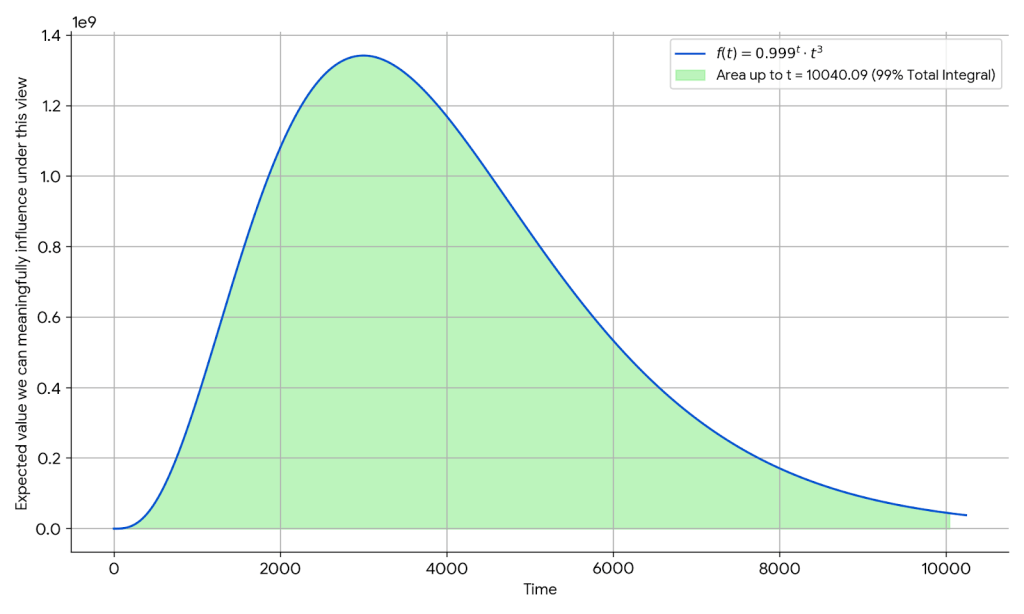
We can also consider a model with a different discount factor and with cubic growth, reflecting the possibility of space expansion radiating from Earth:

On this model, virtually all the expected value we can meaningfully influence is found within the next 10,000 years. In both of the models above, we end up with a sort of de facto “medium-termism”.

Of course, one can vary the parameters in numerous ways and combine multiple models in ways that reflect more sophisticated views of, for example, expected future populations and discount factors. Views that involve temporal discounting allow for much greater variation than what is captured by the toy models above, including views that focus on much shorter or much longer timescales. Moreover, views that involve discounting need not be limited to temporal discounting in particular, or even be phrased in terms of temporal discounting at all. It is one way to incorporate discounting or scope-adjustments, but by no means the only one. 

Furthermore, if we give some plausibility to views that involve discounting of some kind, we need not be committed to a single view for every single domain. We may hold that the best view, or the view we give the greatest weight, will vary depending on the issue at hand (cf. Dancy, 2001; Knutsson, 2023, sec. 3). A reason for such variability may be that the scope of outcomes we can meaningfully predict often differs significantly across domains. For example, there is a stark difference in the predictability of weather systems versus planetary orbits, and similar differences in predictability might be found across various practical and policy-relevant domains.

Note also that a non-clueless scope-adjusted view need not be rigorously formalized; it could, for example, be phrased in terms of our all things considered assessments, which might be informed by myriad formal models, intuitions, considerations, and so on.

Justifications and motivations

What might justify or motivate the basic approach outlined above? This question can be broken into two sub-questions. First, why give weight to more than just a single moral view? Second, provided we give some weight to more than a single view, why give any weight to a scope-adjusted view concerned with consequences?

Why give weight to multiple views?

Reasons for giving weight to more than a single moral view or theory have been explored elsewhere (see e.g. Dancy, 2001; MacAskill et al., 2020, ch. 1; Knutsson, 2023; Vinding, 2023).

One of the reasons that have been given is that no single moral theory seems able to give satisfying answers to all moral questions (Dancy, 2001; Knutsson, 2023). And even if our preferred moral theory appears to be a plausible candidate for answering all moral questions, it is arguably still appropriate to have less than perfect confidence or acceptance in that theory (MacAskill et al., 2020, ch. 1; Vinding, 2023). Such moderation might be grounded in epistemic modesty and humility, a general skepticism toward fanaticism, and the prudence of diversifying one’s bets. It might also be grounded partly in the observation that other thoughtful people hold different moral views and that there is something to be said in favor of those views.

Likewise, giving exclusive weight to a single moral view might make us practically indifferent or paralyzed, whether it be due to cluelessness or due to underspecification as to what our preferred moral theory implies in some real-world situation. Critically, such practical indifference and paralysis may arise even in the face of the most extreme atrocities. If we find this to be an unreasonable practical implication, we arguably have reason not to give exclusive weight to a moral view that potentially implies such paralysis.

Finally, from a perspective that involves degrees of acceptance or agreement with moral views, a reason for giving weight to multiple views might simply be that those moral views each seem intuitively plausible or that we intuitively agree with them to some extent (cf. Knutsson, 2023, sec. 6.6).

Why give weight to a scope-adjusted view?

What reasons could be given for assigning weight to a scope-adjusted view in particular? One reason may be that it seems reasonable to be concerned with consequences to the extent that we can realistically estimate and be guided by them. That is arguably a sensible and intuitive scope for concern about consequences — or at least it appears sensible to some non-zero degree. If we hold this intuition, even if just to a small degree, it seems reasonable to have a final view in which we give some weight to a view focused on realistically assessable consequences (whatever the scope of those consequences ultimately turns out to be).

Some support may also be found in our moral assessments and stances toward local cases of suffering. For example, if we were confronted with an emergency situation in which some individuals were experiencing intense suffering in our immediate vicinity, and if we were readily able to alleviate this suffering, it would seem morally right to help these beings even if we cannot foresee the long-run consequences. (All theoretical and abstract talk aside, I suspect the vast majority of consequentialists would agree with that position in practice.)

Presumably, at least part of what would make such an intervention morally right is the badness of the suffering that we prevent by intervening. And if we hold that it is morally appropriate to intervene to reduce suffering in cases where we can immediately predict the consequences of doing so — namely that we alleviate the suffering right in front of us — it seems plausible to hold that this stance also generalizes to consequences that are less immediate. In other words, if this stance is sound in cases of immediate suffering prevention — or even if it just has some degree of soundness in such cases — it plausibly also has some degree of soundness when it comes to suffering prevention within a broader range of consequences that we can meaningfully estimate and influence.

This is also in line with the view that we have (at least somewhat) greater moral responsibility toward that which occurs within our local sphere of assessable influence. This view is related to, and may be justified in terms of, the “ought implies can” principle. After all, if we are bound to be clueless and unable to deliberately influence very long-run consequences, then, if we accept some version of the “ought implies can” principle, it seems that we cannot have any moral responsibility or moral duties to deliberately shape those long-run consequences — or at least such moral responsibility is plausibly diminished. In contrast, the “ought implies can” principle is perfectly consistent with moral responsibility within the scope of consequences that we realistically can estimate and deliberately influence in a meaningful way.

Thus, if we give some weight to an “ought implies can” conception of moral responsibility, this would seem to support the idea that we have (at least somewhat) greater moral responsibility toward that which occurs within our sphere of assessable influence. An alternative way to phrase it might be to say that our sphere of assessable influence is a special part of the universe for us, in that we are uniquely positioned to predict and steer events in that part compared to elsewhere, and this arguably gives us a (somewhat) special moral responsibility toward that part of the universe.

Another potential reason to give some weight to views centered on realistically assessable consequences, or more generally to views that entail discounting in some form, is that other sensible people endorse such views based on reasons that seem defensible to some degree. For example, it is common for economists to endorse models that involve temporal discounting, not just in descriptive models but also in prescriptive or normative models (see e.g. Arrow et al., 1996). The justifications for such discounting might be that our level of moral concern should be adjusted for uncertainty about whether there will be any future, uncertainty about our ability to deliberately influence the future, and the possibility that the future will be better able to take care of itself and its problems (relative to earlier problems that we could prioritize instead).

One might object that such reasons for discounting should be incorporated at a purely empirical level, without any discounting at the moral level, and I would largely agree with that sentiment. (Note that when applied at a strictly empirical or practical level, those reasons and adjustments are contenders as to how one might avoid paralysis without any discounting at the moral level.)

Yet even if we think such considerations should mostly or almost exclusively be applied at the empirical level, it might still be defensible to also invoke them to justify some measure of discounting directly at the level of one’s moral view and moral concerns, or at least as a tiny sub-component within one’s broader moral view. In other words, it might be defensible to allow empirical considerations of the kind listed above to inform and influence our fundamental moral values, at least to a small degree.

To be clear, it is not just some selection of economists who endorse normative discounting or scope-adjustment in some form. As noted above, it is also found among those who endorse “reasonable consequentialism” and consequentialism framed in terms of foreseeable consequences. And similar views can be found among people who seek to reduce suffering.

For example, Brian Tomasik has long endorsed a kind of split between reducing suffering effectively in the near term versus reducing suffering effectively across all time. In particular, regarding altruistic efforts and donations, he writes that “splitting is rational if you have more than one utility function”, and he devotes at least 40 percent of his resources toward short-term efforts to reduce suffering (Tomasik, 2015). Jesse Clifton seems to partially endorse a similar approach focused on reasons that we can realistically weigh up — an approach that in his view “probably implies restricting attention to near-term consequences” (see also Clifton, 2025). The views endorsed by Tomasik and Clifton explicitly give some degree of special weight to near-term or realistically assessable consequences, and these views and the judgments underlying them seem fairly defensible.

Lastly, it is worth emphasizing just how weak of a claim we are considering here. In particular, in the framework outlined above, all that is required for the simple practical asymmetry argument to go through is that we give any non-zero weight to a non-clueless view focused on realistically assessable consequences, or some other non-clueless view centered on consequences.

That is, we are not talking about accepting this as the most plausible view, or even as a moderately plausible view. Its role in the practical framework above is more that of a humble tiebreaker — a view that we can consult as an nth-best option if other views fail to give us guidance and if we give this kind of view just the slightest weight. And the totality of reasons listed here arguably justify that we grant it at least a tiny degree of plausibility or acceptance.

Arguments I have not made

One could argue that something akin to the approach outlined here would also be optimal for reducing suffering in expectation across all space and time. In particular, one could argue that such an unrestricted moral aim would in practice imply a focus on realistically assessable consequences. I am open to that argument — after all, it is difficult to see what else the recommended focus could be, to the extent there is one.

For similar reasons, one could argue that a practical focus on realistically assessable consequences represents a uniquely safe and reasonable bet from a consequentialist perspective: it is arguably the most plausible candidate for what a consequentialist view would recommend as a practical focus in any case, whether scope-adjusted or not. Thus, from our position of deep uncertainty — including uncertainty about whether we are bound to be clueless — it arguably makes convergent sense to try to estimate the furthest depths of assessable consequences and to seek to act on those estimates, at least to the extent that we are concerned with consequences.

Yet it is worth being clear that the argument I have made here does not rely on any of these claims or arguments. Indeed, it does not rely on any claims about what is optimal for reducing suffering across all space and time.

As suggested above, the conditional claim I have argued for here is ultimately a very weak one about giving minimal weight to what seems like a fairly moderate and in some ways commonsensical moral view or idea (e.g. it seems fairly commonsensical to be concerned with consequences to the extent that we can realistically estimate and be guided by them). The core argument presented in this essay does not require us to accept any controversial empirical positions.

Conclusion

For some of our problems, perhaps the best we can do is to find “second best solutions” — that is, solutions that do not satisfy all our preferred criteria, yet which are nevertheless better than any other realistic solution. This may also be true when it comes to reducing suffering in a potentially infinite universe. We might be in an unpredictable sea of infinite consequences that ripple outward forever (Schwitzgebel, 2024). But even if we are, this need not prevent us from trying to reduce suffering in effective and sensible ways within a realistic scope. After all, compared to simply giving up on trying to reduce suffering, it seems less arbitrary and more plausible to at least try to reduce suffering within the domain of consequences we can realistically assess and be guided by.

Acknowledgments

Thanks to Tobias Baumann, Jesse Clifton, and Simon Knutsson for helpful comments.

Controlling for a thinker’s big idea

This post is an attempt to write up what I consider a useful lesson about intellectual discourse. The lesson, in short, is that it is often helpful to control for a thinker’s big idea. That is, a proponent of a big idea may often overstate the plausibility or significance of their big idea, especially if this thinker’s intellectual persona has become strongly tied to that idea.

This is in some sense a trivial lesson, but it is also a lesson that seems to emerge quite consistently when one does research and tries to form a view on virtually any topic. Since I have not seen anyone write about this basic yet important point, I thought it might be worth doing so here (though others have probably written about it somewhere, and awareness of the phenomenon is no doubt widespread among professional researchers).


Contents

  1. Typical patterns of overstatement, overconfidence, and overemphasis
  2. Analogy to sports fans
  3. Controlling for the distorting influence of overconfidence and skewed emphases
  4. Examples of thinkers with big ideas
    1. Kristin Neff and self-compassion
    2. Jonathan Haidt and the social intuitionist model of moral judgment
    3. David Pinsof and hidden status motives
    4. Robin Hanson and grabby aliens
    5. David Pearce and the abolitionist project
    6. Other examples
  5. Concluding note: The deeper point applies to all of us

Typical patterns of overstatement, overconfidence, and overemphasis

The tendency for a thinker to overstate their big idea often takes the following form: in a condition where many different factors contribute to some given effect, a thinker with a big idea can be inclined to highlight one particular factor, and to then confidently present this one factor as though it is the only relevant one, in effect downplaying other plausible factors.

Another example might be when a thinker narrowly advocates their own approach to a particular problem, whereby they quietly neglect other approaches that may be similarly, or even more, helpful.

In many cases, the overstatement mostly takes the form of skewed emphasis and framing rather than explicit claims about the relative importance of different factors or approaches.

Analogy to sports fans

An illustrative analogy might be sports fans who are deeply invested in their favorite team. For example, if a group of football fans argue that their favorite team is objectively the best one ever, we would rightly be skeptical of this assessment. Likewise, if such fans complain that referee calls against their team tend to be deeply unfair, we should hardly be eager to trust them. The sports fans are not impartial judges on these matters.

While we might prefer to think that intellectuals are fundamentally different from dedicated sports fans, it seems that there are nevertheless some significant similarities. For instance, in both cases, identity and reputation tend to be on the line, and unconscious biases often push beliefs in self-serving directions.

Indeed, across many domains of life, we humans frequently act more like sports fans than we would like to admit. Hence, the point here is not that intellectuals are uniquely similar to sports fans, but simply that intellectuals are also — like everyone else — quite like sports fans in some significant respects, such as when they cheer for their own ideas. (An important corollary of this observation is that we usually need to consult the work of many different thinkers if we are to acquire a balanced picture of a given issue — an insight that is, of course, also widely appreciated among professional researchers.)

I should likewise clarify that my point isn’t that scholars with a big idea cannot be right about their big idea; sometimes they are. My point is merely that if a thinker is promoting some big idea that has become tied to their identity and reputation, then we have good reason to be a priori skeptical of this thinker’s own assessment of the idea. (And, of course, this point about a priori skepticism also applies to me, to the extent that I am advancing any particular idea, big or small.)

Controlling for the distorting influence of overconfidence and skewed emphases

Why do people, both scholars and laypeople, often state their views with excessive confidence? Studies suggest that a big part of the reason is that overconfidence quite simply works at persuading others.

Specifically, in studies where individuals can earn money if they convince others that they did well in an intelligence test, participants tend to display overconfidence in order to be more convincing, and this overconfidence in turn makes them significantly more persuasive to their audience. In other words, overconfidence can be an effective tool for influencing and even outright distorting the beliefs of receivers.

These findings suggest that we actively need to control for overconfidence, lest our minds fall for its seductive powers. Similar points apply to communication that emphasizes some ideas while unduly neglecting others. That is, it is not just overconfidence that can distort the beliefs of receivers, but also the undue neglect of alternative views, interpretations, approaches, and so on (cf. the availability heuristic and other salience-related biases).

Examples of thinkers with big ideas

Below, I will briefly list some examples of thinkers who appear, in my view, to overstate or overemphasize one or more big ideas. I should note that I think each of the thinkers mentioned below has made important contributions that are worth studying closely, even if they may at times overstate their big ideas.

Kristin Neff and self-compassion

Kristin Neff places a strong emphasis on self-compassion. In her own words: “I guess you could say that I am a self-compassion evangelist”. And there is indeed a large literature that supports its wide-ranging benefits, from increased self-control to greater wellbeing. Even so, it seems to me that Neff overemphasizes self-compassion relative to other important traits and constructs, such as compassion for others, which is also associated with various benefits. (In contrast to Neff, many psychologists working in the tradition of compassion-focused therapy display a more balanced focus on compassion for both self and others, see e.g. Gilbert et al., 2011; Kirby et al., 2019.)

One might object that Neff specializes in self-compassion and that she cannot be expected to compare self-compassion to other important traits and constructs. That might be a fair objection, but it is also an objection that in some sense grants the core point of this post, namely that we should not expect scholars to provide a balanced assessment of their own big ideas (relative to other ideas and approaches).

Jonathan Haidt and the social intuitionist model of moral judgment

Jonathan Haidt has prominently defended a social intuitionist approach to moral judgment. Simply put, this model says that our moral judgments are almost always dictated by immediate intuitions and then later rationalized by reasons.

Haidt’s model no doubt has a lot of truth to it, as virtually all of his critics seem to concede: our intuitions do play a large role in forming our moral judgments, and the reasons we give to justify our moral judgments are often just post-hoc rationalizations. The problem, however, is that Haidt appears to greatly understate the role that reasons and reasoning can play in moral judgments. That is, there is a lot of evidence suggesting that moral reasoning often does play an important role in people’s moral judgments, and that it frequently plays a larger role than Haidt’s model seems to allow (see e.g. Narvaez, 2008; Paxton & Greene, 2010; Feinberg et al., 2012).

David Pinsof and hidden status motives

David Pinsof emphasizes the hidden status motives underlying human behavior. In a world where people systematically underestimate the influence of status motives, Pinsof’s work seems like a valuable contribution. Yet it also seems like he often goes too far and overstates the role of status motives at the expense of other motives (which admittedly makes for an interesting story about human behavior). Likewise, it appears that Pinsof makes overly strong claims about the need to hide status motives.

In particular, Pinsof argues that drives for status cannot be openly acknowledged, as that would be self-defeating and undermine our status. Why? Because acknowledging our status drives makes us look like mere status-seekers, and mere status-seekers seem selfish, dishonest, and like they have low status. But this seems inaccurate to me, and like it assumes that humans are entirely driven by status motives, while simultaneously needing to seem altogether uninfluenced by status motives. An alternative view is that status motives exert a significant, though not all-powerful, pull on our behavior, and acknowledging this pull need not make us appear selfish, dishonest, or low-status. On the contrary, admitting that we have status drives (as everyone does) may signal a high level of self-awareness and honesty, and it hardly needs to paint us as selfish or low-status (since again, we are simply acknowledging that we possess some basic drives that are shared by everyone).

It is also worth noting that Pinsof seems to contradict himself in this regard, since he himself openly acknowledges his own status drives, and he does not appear to believe that this open acknowledgment is self-defeating or greatly detrimental to his social status, perhaps quite the contrary. Indeed, by openly discussing both his own and others’ hidden status motives, it seems that Pinsof has greatly boosted his social status rather than undermined it.

Robin Hanson and grabby aliens

Robin Hanson has many big ideas, and he seems overconfident about many of them, from futarchy to grabby aliens. To keep this section short, I will focus on his ideas related to grabby aliens, which basically entail that loud and clearly visible aliens explain why we find ourselves at such an early time in the history of the universe, as such aliens would prevent later origin dates.

To be clear, I think Hanson et al.’s grabby aliens model is an important contribution. The model makes some simplifying assumptions, such as dividing aliens into quiet aliens that “don’t expand or change much” and loud aliens that “visibly change the volumes they control”, and Hanson et al. then proceed to explore the implications of these simplifying assumptions, which makes sense. Where things get problematic, however, is when Hanson goes on to make strong statements based on his model, without adding the qualification that his conclusions rely on some strong and highly simplifying assumptions. An example of a strong statement is the claim that loud aliens are “our most robust explanation for why humans have appeared so early in the history of the universe.”

Yet there are many ways in which the simplifying assumptions of the model might be wrong, and which Hanson seems to either ignore or overconfidently dismiss. To mention just two: First, it is conceivable that much later origin dates are impossible, or at least prohibitively improbable, due to certain stellar and planetary conditions becoming highly unfavorable to complex life in the future (cf. Burnetti, 2016; 2017). Since we do not have a good understanding of the conditions necessary for the evolution of complex life, it seems that we ought to place a significant probability on this possibility (while also placing a significant probability on the assumption that the evolution of complex life will remain possible for at least a trillion years).

Second, Hanson et al.’s basic model might be wrong in that expansionist alien civilizations could generally converge to be quiet, in the sense of not being clearly visible; or at least some fraction of expansionist civilizations could be quiet (both possibilities are excluded by Hanson et al.’s model). This is not a minor detail, since if we admit the possibility of such aliens, then our observations do not necessarily give us much evidence about expansionist aliens, and such aliens could even be here already. Likewise, quiet expansionist aliens could be the explanation for early origin dates rather than loud expansionist ones.

When considering such alternative explanations, it becomes clear that the claim that loud aliens explain our seemingly early position in time is just one among many hypotheses, and it is quite debatable whether it is the most plausible or robust one (see also Friederich & Wenmackers, 2023).

David Pearce and the abolitionist project

David Pearce is another thinker who has many big and profound ideas. By far the biggest of these ideas is that we should use biotechnology to abolish suffering throughout the living world, what he calls the abolitionist project. This is an idea that I strongly support in principle. Yet where I would disagree with Pearce, and where it seems to me that he is overconfident, is when it comes to the question of whether pushing for the abolitionist project is the best use of marginal resources for those seeking to reduce suffering.

Specifically, when we consider the risk of worst-case outcomes due to bad values and political dynamics, it seems likely that other aims are more pressing, such as increasing the priority that humanity devotes to the reduction of suffering, as well as improving our institutions such that they are less prone to worst-case outcomes (see also Tomasik, 2016; Vinding, 2020, ch. 13; 2021; 2022). At the very least, it seems that there is considerable uncertainty as to which specific priorities are most helpful for reducing suffering.

Other examples

Some other examples of thinkers who appear to overstate their big ideas include Bryan Caplan and Jason Brennan with their strong statements against democracy (see e.g. Farrell et al., 2022), as well as Paul Bloom when he makes strong claims against the utility of emotional empathy (see e.g. Christov-Moore & Iacoboni, 2014; Ashar et al., 2017; Barish, 2023).

Indeed, Bloom’s widely publicized case against empathy is a good example of how this tendency of overstatement is not confined to just a single individual, as there is also an inclination among publishers and the media to amplify strong and dramatic claims that capture people’s attention. This can serve as yet another force that pushes us toward hearing strong claims and simple narratives, and away from getting sober and accurate perspectives, which are often more complex and nuanced. (For example, contrast Bloom’s case against empathy with the more complex perspective that emerges in Ashar et al., 2017.)

Concluding note: The deeper point applies to all of us

Both for promoters and consumers of ideas, it is worth being wary of the tendency to become unduly attached to any single idea or perspective (i.e. attached based on insufficient reasons or evidence). Such attachment can skew our interpretations and ultimately get in the way of a commitment to form more complete and informed perspectives on important issues.

Consciousness: Orthogonal or Crucial?

The following is an excerpt from my book Reflections on Intelligence (2016/2024).


A question that is often considered open, sometimes even irrelevant, when it comes to “AGIs” and “superintelligences” is whether such entities would be conscious. Here is Nick Bostrom expressing such a sentiment:

By a “superintelligence” we mean an intellect that is much smarter than the best human brains in practically every field, including scientific creativity, general wisdom and social skills. This definition leaves open how the superintelligence is implemented: it could be a digital computer, an ensemble of networked computers, cultured cortical tissue or what have you. It also leaves open whether the superintelligence is conscious and has subjective experiences. (Bostrom, 2012, “Definition of ‘superintelligence’”)

Yet this is hardly true. If a system is “more capable than the best human brains in practically every field, including scientific creativity, general wisdom, and social skills”, the question of consciousness is highly relevant. Consciousness is integral to much of what we do and excel at, and thus if an entity is not conscious, it cannot outperform the best humans “in practically every field”, especially not in “general wisdom” and “scientific creativity”. Let us look at these in turn.

General Wisdom

A core aspect of “general wisdom” is to be wise about ethical issues. Yet being wise about ethical issues requires that one can consider and evaluate questions like the following in an informed manner:

  • Is there anything about the experience of suffering that makes its reduction a moral priority
  • Does anything about the experience of suffering justify the claim that reducing suffering has greater moral priority than increasing happiness (for the already happy)?
  • Is there anything about states of extreme suffering that make their reduction an overriding moral priority?

It seems that one would have to be conscious in order to explore and answer such questions in an informed way. That is, one would have to know what such experiences are like in order to understand their experiential properties and significance. Knowing what a term like “suffering” refers to — i.e. knowing what actual experiences of suffering are like — is thus crucial for informed ethical reflection.

The same point holds true about other areas of philosophy that bear on wisdom, such as the philosophy of mind: without knowing what it is like to have a conscious mind, one cannot contribute much to the discussion about what it is like to have one and to the exploration of different modes of consciousness. Indeed, an unconscious entity has no genuine understanding about what the issue of consciousness is even about in the first place (Pearce, 2012a; 2012b).

So both in ethics and in the philosophy of mind, an unconscious entity would be less than clueless about many of the deepest questions at hand. If an entity not only fails to surpass humans in these areas, but fails to even have the slightest clue about what we are talking about, it hardly surpasses the best humans in practically every field. After all, questions about the phenomenology of consciousness are also relevant to many other fields, including psychology, epistemology, and ontology.

In short, experiencing and reasoning about consciousness is a key part of “human abilities”, and hence an entity that is unable to do this cannot be claimed to outperform humans in the most important, much less all, human abilities (see also Pearce, 2012a; 2012b).

Scientific Creativity

Another ability mentioned above that an unconscious entity could supposedly outdo humans at is scientific creativity. Yet scientific creativity must relate to all fields of knowledge, including the science of the conscious mind itself. This is also a part of the natural world, and a most relevant one at that.

Experiencing and accurately reporting what a given state of consciousness is like is essential for the science of mind, yet an unconscious entity obviously cannot do such a thing, as there is no experience it can report from. It cannot display any genuine scientific creativity, or even produce mere observations, in the direct exploration of consciousness.

Physics Is Also Qualia

In this post, I seek to clarify what I consider to be some common confusions about consciousness and “physics” stemming from a failure to distinguish clearly between ontological and epistemological senses of “physics”.

Clarifying Terms

Two senses of the word “physics” are worth distinguishing. There is physics in an ontological sense: roughly speaking, the spatio-temporal(-seeming) world that in many ways conforms well to our best physical theories. And then there is physics in an epistemological sense: a certain class of models we have of this world, the science of physics.

“Physics” in this latter, epistemological sense can be further divided into 1) the physical models we have in our minds, versus 2) the models we have external to our minds, such as in our physics textbooks and computer simulations. Yet it is worth noting that, to the extent we ourselves have any knowledge of the models in our books and simulations, we only have this knowledge by representing it in our minds. Thus, ultimately, all the knowledge of physical models we have, as subjects, is knowledge of the first kind: as appearances in our minds.*

In light of these very different senses of the term “physics”, it is clear that the claim that “physics is also qualia” can be understood in two very different ways: 1) in the sense that the physical world, in the ontological sense, is qualia, or “phenomenal”, and 2) that our models of physics are qualia, i.e. that our models of physics are certain patterns of consciousness. The first of these two claims is surely the most controversial one, and I shall not defend it here; I explore it here and here.

Instead, I shall here focus on the latter claim. My aim is not really to defend it, as I already briefly did that above: all the knowledge of physics we have, as subjects, ultimately appears as experiential patterns in our minds. (Although talk of the phenomenology of, say, operations in Hilbert spaces admittedly is rare.) I take this to be obvious, and hit an impasse with anyone who disagrees. My aim here is rather to clarify some confusions that arise due to a lack of clarity about this, and due to conflations of the two senses of “physics” described above.

The Problem of Reduction: Epistemological or Ontological?

I find it worth quoting the following excerpt from a Big Think interview with Sam Harris. Not because there is anything atypical about what Harris says, but rather because I think he here clearly illustrates the prevailing lack of clarity about the distinction between epistemology and ontology in relation to “the physical”.

If there’s an experiential internal qualitative dimension to any physical system then that is consciousness. And we can’t reduce the experiential side to talk of information processing and neurotransmitters and states of the brain […]. Someone like Francis Crick said famously you’re nothing but a pack of neurons. And that misses the fact that half of the reality we’re talking about is the qualitative experiential side. So when you’re trying to study human consciousness, for instance, by looking at states of the brain, all you can do is correlate experiential changes with changes in brain states. But no matter how tight these correlations become that never gives you license to throw out the first person experiential side. That would be analogous to saying that if you just flipped a coin long enough you would realize it had only one side. And now it’s true you can be committed to talking about just one side. You can say that heads being up is just a case of tails being down. But that doesn’t actually reduce one side of reality to the other.

Especially worth resting on here is the statement “half of the reality we’re talking about is the qualitative experiential side.” Yet is this “half of reality” an “ontological half” or an “epistemological half”? That is, is there a half of reality out there that is part phenomenal, and part “non-phenomenal” — perhaps “inertly physical”? Or are we rather talking about two different phenomenal descriptions of the same thing, respectively 1) physico-mathematical models of the mind-brain (and these models, again, are also qualia, i.e. patterns of consciousness), and 2) all other phenomenal descriptions, i.e. those drawing on the countless other experiential modalities we can currently conceive of — emotions, sounds, colors, etc. — as well as those we can’t? I suggest we are really talking about two different descriptions of the same thing.

A similar question can be raised in relation to Harris’ claim that we cannot “reduce one side of reality to the other.” Is the reduction in question, or rather failure of reduction, an ontological or an epistemological one? If it is ontological, then it is unclear what this means. Is it that one side of reality cannot “be” the other? This does not appear to be Harris’ view, even if he does tacitly buy into ontologically distinct sides (as opposed to descriptions) of reality in the first place.

Yet if the failure of reduction is epistemological, then there is in fact little unusual about it, as failures of epistemological reduction, or reductions from one model to another, are found everywhere in science. In the abstract sciences, for example, one axiomatic system does not necessarily reduce to another; indeed, we can readily create different axiomatic systems that not only fail to reduce to each other yet which actively contradict each other. And hence we cannot derive all of mathematics, broadly construed, from a single axiomatic system.

Similarly, in the empirical sciences, economics does not “reduce to” quantum physics. One may object that economics does reduce to quantum physics in principle, yet it should then be noted that 1) the term “in principle” does an enormous amount of work here, arguably about as much as it would have to do in the claim that “quantum physics can explain consciousness in principle” — after all, physics and economics invoke very different models and experiential modalities (economic theories are often qualitative in nature, and some prominent economists have even argued they are primarily so). And 2) a serious case can be made against the claim that even all the basic laws found in chemistry, the closest neighbor of physics, can be derived from fundamental physical theories, even in principle (see e.g. Berofsky, 2012, chap. 8). This case does not rest on there being something mysterious going on between our transition from theories of physics to theories of chemistry, nor that new fundamental forces are implicated, but merely that our models in these respective fields contain elements not reducible, even in principle, to our models in other areas.

Thus, at the level of our minds, we can clearly construct many different mental models which we cannot reduce to each other, even in principle. Yet this merely says something about our models and epistemology. It hardly comprises a deep metaphysical mystery.

Denying the Reality of Consciousness

The fact that the world conforms, at least roughly, to description in “physical” terms seems to have led some people to deny that consciousness in general exists. Yet this, I submit, is a fallacy: the fact that we can model the world in one set of terms which describe certain of its properties does not imply that we cannot describe it in another set of terms that describe other properties truly there as well, even if we cannot derive one from the other.

By analogy, consider again physics and economics: we can take the exact same object of study — say, a human society — and describe aspects of it in physical terms (with models of thermodynamics, classical mechanics, electrodynamics, etc.), yet we cannot from any such description or set of descriptions meaningfully derive a description of the economics of this society. It would clearly be a fallacy to suggest that this implies facts of economics cannot exist.

Again, I think the confusion derives from conflating epistemology with ontology: “physics”, in the epistemological sense of “descriptions of the world in physico-mathematical terms”, appears to encompass “everything out there”, and hence, the reasoning goes, nothing else can exist out there. Of course, in one sense, this is true: if a description in physico-mathematical terms exhaustively describes everything out there, then there is indeed nothing more to be said about it — in physico-mathematical terms. Yet this says nothing about the properties of what is out there in other terms, as illustrated by the economics example above. (Another reason some people seem to deny the reality of consciousness, distinct from conflation of the epistemological and the ontological, is “denial due to fuzziness”, which I have addressed here.)

This relates, I think, to the fundamental Kantian insight on epistemology: we never experience the world “out there” directly, only our own models of it. And the fact that our physical model of the world — including, say, a physical model of the mind-brain of one’s best friend — does not entail other phenomenal modalities, such as emotions, by no means implies that the real, ontological object out there which our physical model reflects, such as our friend’s actual mind-brain, does not instantiate these things. That would be to confuse the map with the territory. (Our emotional model of our best friend does, of course, entail emotions, and it would be just as much of a fallacy to say that, since such emotional models say nothing about brains in physical terms, descriptions of the latter kind have no validity.)

Denials of this sort can have serious ethical consequences, not least since the most relevant aspects of consciousness, including suffering, fall outside descriptions of the world in purely physical terms. Thus, if we insist that only such physico-mathematical descriptions truly describe the world, we seem forced to conclude that suffering, along with everything else that plausibly has moral significance, does not truly exist. Which, in turn, can keep us from working toward a sophisticated understanding of these things, and from creating a better world accordingly.


* And for this reason, the answer to the question “how do you know you are conscious?” will ultimately be the same as the answer to the question “how do you know physics (i.e. physical models) exist?” — we experience these facts directly.

In Defense of Nuance

The world is complex. Yet most of our popular stories and ideologies tend not to reflect this complexity. Which is to say that our stories and ideologies, and by extension we, tend to have insufficiently nuanced perspectives on the world.

Indeed, falling into a simple narrative through which we can easily categorize and make sense of the world — e.g. “it’s all God’s will”; “it’s all class struggle”; “it’s all the muslims’ fault”; “it’s all a matter of interwoven forms of oppression” — is a natural and extremely powerful human temptation. And something social constructivists get very right is that this narrative, the lens through which we see the world, influences our experience of the world to an extent that is difficult to appreciate.

So much more important, then, that we suspend our urge to embrace simplistic narratives to (mis)understand the world through. In order to navigate wisely in the world, we need to have views that reflect its true complexity — not views that merely satisfy our need for simplicity (and social signaling; more on this below). For although simplicity can be efficient, and to some extent is necessary, it can also, when too much too relevant detail is left out, be terribly costly. And relative to the needs of our time, I think most of us naturally err on the side of being expensively unnuanced, painting a picture of the world with far too few colors.

Thus, the straightforward remedy I shall propose and argue for here is that we need to control for this. We need to make a conscious effort to gain more nuanced perspectives. This is necessary as a general matter, I believe, if we are to be balanced and well-considered individuals who steer clear of self-imposed delusions. Yet it is also necessary for our time in particular. More specifically, it is essential in addressing the crisis that human conversation seems to be facing in the Western world today — a crisis that largely seems the result of an insufficient amount of nuance in our perspectives.

Some Remarks on Human Nature

There are certain facts about the human condition that we need to put on the table and contend with. These are facts about our limits and fallibility that should give us all pause about what we think we know — both about the world in general and about ourselves in particular.

For one, we have a whole host of well-documented cognitive biases. There are far too many for me to list them all here, yet some of the most important ones are: confirmation bias (the tendency of our minds to search for, interpret, and recall information that confirms our pre-existing beliefs); wishful thinking (our tendency to believe what we wish were true); and overconfidence bias (our tendency to have excessive confidence in our own beliefs — in one study, people who reported to be 100 percent certain about their answer to a question were correct less than 85 percent of the time). And while we can probably all recognize these pitfalls in other people, it is much more difficult to realize and admit that they afflict ourselves as well. In fact, our reluctance to realize this is itself a well-documented bias, known as the bias blindspot.

Beyond acknowledging that we have fallible minds, it is also helpful to understand the deeper context that has given rise to much of this fallibility, and which continues to fuel it, namely our social context — both the social context of our evolutionary history as well as that of our present condition. We humans are deeply social creatures, which shows at every level of our design, including the level of our belief formation. And we need to be acutely aware of this if we are to form reasonable beliefs with minimal amounts of self-deception.

Yet not only are we social creatures, we are also, by nature, deeply tribal creatures. As psychologist Henri Tajfel showed, one need only assign one group of randomly selected people the letter “A” and another randomly selected group the letter “B” in order for a surprisingly strong in-group favoritism to emerge. This method for studying human behavior is known as the minimal group paradigm, and it shows something about us that history should already have taught us a long time ago: that human tribalism is like gasoline just waiting for a little spark to be ignited.

Our social and tribal nature has implications for how we act and what we believe. It is, for instance, largely what explains the phenomenon of groupthink, which is when our natural tendency toward (in-)group conformity leads to a lack of dissenting viewpoints among individuals in a given group, which in turn leads to poor decisions by these individuals.

Indeed, our beliefs about the world are far more socially influenced than we tend to realize, not just in that we get our views from others around us, but also in that we often believe things in order to signal to others that we possess certain desirable traits, or to signal that we are loyal to them. This latter way of thinking about our beliefs is quite at odds with how we prefer to think about ourselves, yet the evidence for this unflattering view is difficult to deny at this point.

As authors Robin Hanson and Kevin Simler argue in their recent book The Elephant in the Brain, we humans are strategically self-deceived about our own motives, including when it comes to what motivates our beliefs. Beliefs, they argue, serve more functions than just the function of keeping track of what is true of the world. For while beliefs surely do serve this practical function, they also often serve a very different, very social function, namely to show others what kind of person we are and what kind of groups we identify with. This makes beliefs much like clothes, which have the practical function of keeping us warm while, for most of us, also serving the function of signaling our tastes and group affiliations. One of Hanson and Simler’s main points is that we are not consciously aware that our beliefs have these distinct functions, and that there is an evolutionary reason for this: if we realized (clearly) that we believe certain things for social reasons, and if we realized that we display our beliefs with overconfidence, we would be much less convincing to those we are trying to convince and impress.

Practical Implications of Our Nature

The preceding survey of the pitfalls and fallibilities of our minds is far from exhaustive, of course, but it shall suffice for our purposes. The bottom line is that we are creatures who want to see our pre-existing beliefs confirmed, and who tend to display excessive confidence in these beliefs. We do this in a social context, and many of the beliefs we hold serve social rather than epistemic functions, which include the tribal function of showing others how loyal we are to certain groups, as well as how worthy we are as friends and mates. In other words, we have a natural pull to impress our peers, not just with our behavior but also with our beliefs. And for socially strategic reasons, we are quite blind to the fact that we do this.

So what, then, is the upshot of all of this? A general implication, I submit, is that we have a lot to control for if we aspire to have reasonable beliefs, and our own lazy mind, with all its blindspots and craving for simple comfort, is not our friend in this endeavor. The fact that we are naturally biased and tendentious gives us reason to doubt our own beliefs and motives. More than that, it gives us reason to actively seek out the counter-perspectives and nuance that our confirmation bias so persistently struggles to keep us from accessing.

Reducing Our Biases

If we are to form accurate and nuanced perspectives, it seems helpful to cultivate an awareness of our biases, and to make an active effort to curb them.

Countering Confirmation Bias

To counteract our confirmation bias, it is critical to seek out viewpoints and arguments that challenge our pre-existing beliefs. We all cherry-pick data a little bit here and there in favor of our own position, and so by hearing from people with opposing views, and by examining their cherry-picked data and their particular emphases and interpretations, we will, in the aggregate, tend to get a more balanced picture of the issues at hand.

Important in this respect is that we engage with these other views in a charitable way, by assuming good faith on behalf of the proponents of any position; by trying to understand their view as well as possible; and by then engaging with the strongest possible version of that position — i.e. the steelman rather than the strawman version of it.

Countering Wishful Thinking

Our propensity for wishful thinking should make us skeptical of beliefs that are convenient and which match up with what we want to be true. If we want there to be a God, and we believe that there is one, then this should make us at least a little skeptical of this convenient belief. By extension, our attraction toward the wishful also suggests that we should pay more attention to information and arguments that are inconvenient or otherwise contrary to what we wish were true. Do we believe that the adoption of a vegan lifestyle would be highly inconvenient for us personally? Then we should probably expect to be more than a little biased against any argument in its favor; and if we suspect that the argument has merit, we will likely be inclined to ignore it altogether rather than giving it a fair hearing.

Countering Overconfidence Bias

When it comes to reducing our overconfidence bias, intellectual humility is a key virtue. That is, to admit and speak as though we have a limited and fallible perspective on things. In this respect, it also helps to be aware of the social motives that might be driving our overconfidence much of the time, such as the motive of convincing others or to signal our traits and loyalties. These social functions of confidence give us reason to update away from bravado and toward being more measured.

Countering In-Group Conformity

As hinted above, our beliefs are subject to in-group favoritism, which highlights the importance of being (especially) skeptical of the beliefs we share with groups that we affiliate closely with, while being extra charitable toward the beliefs held by the notional out-group. Likewise, it is worth being aware that our minds often paint the out-group in an unfairly unfavorable light, viewing them as much less sincere and well-intentioned than they actually are.

Thinking in Degrees of Certainty

Many of us have a tendency to express our views in a very binary, 0-or-1 fashion. We tend to be either clearly for something or clearly against it, be it abortion, efforts to prevent climate change, or universal health care. And it seems that what we express outwardly is generally much more absolutist, i.e. more purely 0 or 1, than what happens inwardly — underneath our conscious awareness — where there is probably more conflicting data than what we are aware of and allow ourselves to admit.

I have observed this pattern in conversations: people will argue strongly for a given position that they continue to insist on until, quite suddenly, they say that they accept the opposite conclusion. In terms of their outward behavior, they went from 0 to 1 quite rapidly, although it seems likely that the process that took place underneath the hood was much more continuous — a more gradual move from 0 to 1.

An extreme example of similar behavior found in recent events is that of Omarosa Manigault Newman, who was the Director of African-American Outreach for Donald Trump’s presidential campaign in 2016. She went from describing Trump in adulating terms, calling him “a trailblazer on women’s issues”, to being strongly against him and calling him a racist and a misogynist. It seems unlikely that this shift was based purely on evidence she encountered after she made her adulating statements. There probably was a lot of information in her brain that contradicted those flattering statements, but which she ignored and suppressed. And the reason why is quite obvious: she had a political motive. She needed to broadcast the message that Trump was a good person to further a campaign and to further her own career tied to this campaign. It was about signaling first, not truth-tracking.

The important thing to realize, of course, is that this applies to all of us. We are all inclined to be more like a politician than a scientist in many situations. In particular, we are all inclined to believe and express either a pure 0 or a pure 1 for social reasons.

Fortunately, there is a corrective for our tendency toward 0-or-1 thinking, which is to think in terms of credences along a continuum, ranging from 0 to 1. Thinking in these terms can help make our expressed beliefs more refined and more faithful to the potentially contradicting information found in our brains. Additionally, such graded thinking may help subvert the tribal aspect of our either-or thinking, by moving us away from a framework of binary polarity and instead placing us all in the same boat: the boat of degrees of certainty, in which the only thing that differs between us is our level of certainty in any given claim.

Such an honest, more detailed description of one’s beliefs is not good for keeping groups divided by different beliefs. Indeed, it is good for the exact opposite: it helps us move toward a more open and sincere conversation about what we in fact believe and why, regardless of our group affiliations.

Different Perspectives Can Be Equally True

There are two common definitions of the term “perspective” that are quite different, yet closely related. One is “a mental outlook/point of view”, while the other is “the art of representing three-dimensional objects on a two-dimensional surface”. These definitions are related in that the latter can be viewed as a metaphor for the former: our particular perspective, the representation of the world we call our point of view, is in a sense a limited representation of a more complex, multi-dimensional reality — a representation that is bound to leave out a lot of information about the world at large. The best we can do, then, is to try to paint the canvas of our mind so as to make it as rich and informative as possible about the complex and many-faceted world we inhabit.

An important point for us to realize in our quest for more balanced and nuanced views, as well as for the betterment of human conversation, is that seemingly conflicting reports of different perspectives on the same underlying reality can all be true, as hinted by the following illustration:

oscardamen

The same object can have different reflections when viewed from different angles. Similarly, the same events can be viewed very differently by different people who each have their own unique dispositions and prior experiences. And these different views can all be true; John really does see X when he looks at this event, while Jane really does see Y. And, like the different reflections shown above, X and Y need not be incompatible. (A similar sentiment is reflected in the Jain doctrine of Anekantavada.)

And even when someone does get something wrong, they may nonetheless still be truthfully reporting the appearance of the world as it is revealed to them. For example, to many of us, it really does seem as though the lines in the following picture are not parallel, although they in fact are:

1024px-Café_wall.svg

This is merely to state the obvious point that it is possible, indeed quite common, to be perfectly honest and wrong at the same time, which is worth keeping in mind when we engage with people whom we think are obviously wrong; they usually think that they are right, and that we are obviously wrong — and perhaps even dishonest.

Another important point the visual illusion above hints at is that we should be careful not to confuse external reality with our representation of it. Our conscious experience of the external world is not, obviously, the external world itself. And yet we tend to speak as though it were.

This is no doubt an evolutionarily adaptive illusion, but it is an illusion nonetheless. All we ever inhabit is, in the words of David Pearce, our own world-simulation, a world of conscious experience residing in our head. And given that we all find ourselves stuck in — or indeed as — such separate, albeit mutually communicating bubbles, it is not so strange that we can have so many disagreements about what reality is like. All we have to go on is our own private, phenomenal cartoon model of each other and the world at large; a cartoon model that may get many things right, but which is also sure to miss a lot of important facts and phenomena.

Framing Shapes Our Perspective

From the vantage point of our respective world-simulations, we each interpret information from the external world with our own unique framing. And this framing partly determines how we will experience what we observe, as demonstrated by the following illustration, where one can change one’s framing so as to either see a duck or a rabbit:

Sometimes, as in the example above, our framing is readily alterable. In other cases, however, it can be more difficult to just switch our framing, as when it comes to how people with different life experiences will naturally interpret the same scenario. After all, we each experience the world in different ways, due to our unique biological dispositions and life experiences. And while differing outlooks are not necessarily incompatible, it can still be challenging to achieve mutual understanding between perspectives that are shaped by very different experiences and cultural backgrounds.

Acknowledging Many Perspectives Is Not a Denial of Truth

None of the above implies the relativistic claim that there are no truths. On the contrary, the above implies that it is itself a truth that different individuals can have different perspectives and experiences in reaction to the same external reality, and that it is possible for such differing perspectives to all have merit, even if they appear to be in tension with each other. This middle-position of rejecting both the claim that there is only one valid perspective and the claim that there are no truths is, I submit, the only reasonable one on offer.

The fact that there can be merit in a plurality of perspectives implies that, beyond conceiving of our credences along a continuum ranging from 0 to 1, we also need to think in terms of a diversity of continua in a more general sense if we are to gain a nuanced understanding that does justice to reality, including the people around us with whom we interact. More than just thinking in terms of shades of grey found in between the two endpoints of black and white, we need to think in terms of many different shades of many different colors.

At the same time, it is also important to acknowledge the limits of our understanding of other minds and of experiences that we have not had. This does not amount to some obscure claim about how we each have our own, wholly incommensurable experiences, and hence that mutual understanding between individuals with different backgrounds is impossible. Rather, it is simply to acknowledge that psychological diversity is real, which implies that we should be careful to avoid the so-called typical mind fallacy (i.e. the mistake of thinking that other minds work just like our own). More than that, admitting the limits of our understanding of others’ experiences is to acknowledge that at least some experiences just cannot be conveyed faithfully with words alone to those who have not had them. For example, most of us have never tried experiencing extreme forms of suffering, such as the experience of being burned alive, and hence we are largely ignorant about the nature of such experiences.

However, this realization that we do not know what certain experiences are like is itself an important insight that expands and advances our outlook. For it at least helps us realize that our own understanding, as well as the variety of experiences that we are familiar with, are quite limited. With this realization in mind, we can look upon a state of absolute horror and admit that we have virtually no understanding of just how bad it is, which I submit represents a significantly greater level of understanding than does beholding such a state of horror without acknowledging of our lack of comprehension. The realization that we are ignorant itself constitutes knowledge of sorts — the kind of knowledge that makes us rightfully humble.

Grains of Truth in Different Perspectives

Even when two different perspectives are in conflict with each other, this does not imply that they are both entirely wrong, as there can still be significant grains of truth in both of them. Most of today’s popular narratives make a wide range of claims and arguments, and even if not all of these stand up to scrutiny, many of them arguably do. And part of being charitable is to seek out such grains of truth in positions that one does not agree with. This can also help give us a better sense of which realities and plausible claims might motivate people to support (what we consider) misguided views, and thus help advance mutual understanding.

As mentioned earlier, it is possible for different perspectives to support what seem to be very different positions on the same subject without necessarily being wrong; if they have different lenses, looking in different directions. Indeed, different perspectives on the same issue are often merely the result of different emphases that each focus on certain framings and sets of data rather than others. This is, I believe, a common pattern in human conversation: when different views on the same subject are all mostly true, yet where each of them merely constitute a small piece of the full picture — a pattern that further highlights the importance of seeking out different perspectives.

Having made a general case for nuance, let us now turn our gaze toward our time in particular, and why it is especially important to actively seek to be nuanced and charitable today.

Our Time Is Different: The Age of Screen Communication

Every period in history likely sees itself as uniquely special. Yet in terms of how humanity communicates, it appears that our time indeed is a highly unique one. Never before in history has human communication been so screen-based as it is today, which has significant implications for how and what we communicate.

Our brain seems to process communication through a screen in a very different way than it processes face-to-face communication. Writing a message in a Facebook group consisting of a thousand people does not, for most of us, feel remotely the same as delivering an equivalent speech in front of a live audience of a thousand people. And a similar discrepancy between the two forms of communication is found when we interact with just a single person. This is no wonder. After all, communication through a screen consists of a string of black and white symbols. Face-to-face interaction, in contrast, is composed of multiple streams of information; we read off important cues from a person’s face and posture, as well as from the tone and pace of their voice.

All this information provides a much more comprehensive — one might say more nuanced — picture of the state of mind of the person that we are interacting with. We get the verbal content of the conversation (as we would through a screen), plus a ton of information about the emotional state of the person who communicates. And beyond being informative, this information also serves the purpose of making the other person relatable. It makes the reality of their individuality and emotions almost impossible to deny, which is much less true when we communicate through a screen.

Indeed, it is as though these two forms of communication activate quite different sets of brain circuits — not only in that we communicate via a much broader bandwidth and likely see each other as more relatable when we communicate face-to-face, but also in that face-to-face communication naturally motivates us to be civil and agreeable. When we are in the direct physical presence of someone else, we have a strong interest in keeping things civil enough to allow our co-existence in the same physical space. Yet when we interact through a screen, this is no longer a necessity.

These differences between the two forms of communication give us reason to try to be especially nuanced when communicating through screens, not least because written communication through a screen makes it easier than ever before to paint the out-group antagonists whom we interact with in an unreasonably unfavorable light.

Indeed, our modern means of communication arguably make it easier than ever before to not interact with the out-group at all, as the internet has made it possible for us to diverge into our own respective echo chambers to an extent not possible in the past. It is thus easy to end up in communities in which we continuously echo data that supports our own narrative, which ultimately gives us a one-sided and distorted picture of reality. And while it may also be easier than ever before to find counter-perspectives if we were to look for them, this is of little use if we mostly find ourselves collectively indulging in our own in-group confirmation bias, as we often do. For instance, feminists may find themselves mostly informing each other about how women are being discriminated against, while men’s rights activists may disproportionally share and discuss ways in which men are being discriminated against. And so by joining only one of these communities, one is likely to end up with a skewed and insufficiently nuanced picture of reality.

With all the information we have reviewed thus far in mind, let us now turn to some concrete examples of heated issues that divide people today, and where more nuanced perspectives and a greater commitment to being charitable seem desperately needed. I should note that, given the brevity of the following remarks, what I write here on these issues is itself bound to fail to express a highly nuanced perspective, as that would require a longer treatment. Nonetheless, the following brief remarks will at least gesture at some ways in which we can try to be more nuanced about these topics.

Sex Discrimination

As hinted above, there are different groups that seem to tell very different stories about the state of sex discrimination in our world today. On the one hand, there are feminists who seem to argue that women generally face much more discrimination than men, and on the other, there are men’s rights activists who seem to argue that men are, at least in some parts of the world, generally the more discriminated sex. These two claims surely cannot both be right, can they?

If one were to define sex discrimination in terms of some single general measure, a “General Discrimination Factor”, then they could not both be right. Yet if one instead talks about concrete forms of discrimination, it is entirely possible, and indeed clearly the case, that women face more discrimination than men in some respects, while men face more discrimination in other respects. And it is arguably also more fruitful to talk about such concrete cases than it is to talk about discrimination “in general”. (In response to those who think that it is obvious that women face more discrimination in every domain, I would recommend watching the documentary The Red Pill, and for a more academic treatment, reading David Benatar’s The Second Sexism.)

For example, it is a well-known fact that women have, historically, been granted the right to vote much later than men have, which undeniably constitutes a severe form of discrimination against women. Similarly, women have also historically been denied the right to pursue a formal education, and they still are in many parts of the world. In general, women have been denied many of the opportunities that men have had, including access to professions in which they were clearly more than competent to contribute. These are all undeniable facts about undeniably serious forms of discrimination.

However, tempting as it may be to infer, none of this implies that men have not also faced severe discrimination in the past, nor that they avoid such discrimination today. For example, it is generally only men who have been subject to military conscription, i.e. forced duty to enlist in the military. Historically, as well as today, men have — in vastly disproportional numbers — been forced by law to join the military and to go to war, often without returning. (As a side note, it is worth noting that many feminists have criticized conscription.)

Thus, on a global level, it is true to say that, historically as well as today, women have generally faced more discrimination in terms of their rights to vote and to pursue an education, as well as in their professional opportunities, while men have faced more discrimination in terms of state-enforced duties.

Different forms of discrimination against men and women are also present at various other levels. For example, in one study where the same job application was sent to different scientists, and where half of the applications had a female name on them, the other half a male name, the “female applicants” were generally rated as less competent, and the scientists were willing to pay the “male applicants” more than 14 percent more.

The same general pattern seems reported by those who have conducted a controlled experiment in being a man and a woman from the “inside”, namely from transgender men (those who have transitioned from being a woman to being a man). Many of these men report being viewed as more competent after their transition, as well as being listened to more and interrupted less. This fits with the finding that both men and women seem to interrupt women more than they interrupt men.

At the same time, many of these transgender men also report that people seem to care less about them now that they are men. As one transgender man wrote about the change in his experience:

What continues to strike me is the significant reduction in friendliness and kindness now extended to me in public spaces. It now feels as though I am on my own: No one, outside of family and close friends, is paying any attention to my well-being.

Such anecdotal reports seem in line with the finding that both men and women show more aggression toward men than they do toward women, as well as with recent research led by social psychologist Tania Reynolds, which among other things found that:

… female harm or disadvantage evoked more sympathy and outrage and was perceived as more unfair than equivalent male harm or disadvantage. Participants more strongly blamed men for their own disadvantages, were more supportive of policies that favored women, and donated more to a female-only (vs male-only) homeless shelter. Female participants showed a stronger in-group bias, perceiving women’s harm as more problematic and more strongly endorsed policies that favored women.

It thus seems that men and women are generally discriminated against in different ways. And it is worth noting that these different forms of discrimination are probably in part the natural products of our evolutionary history rather than some deliberate, premeditated conspiracy (which is obviously not to say that they are ethically justified).

Yet deliberation and premeditation is exactly what is required if we are to step beyond such discrimination. More generally, what seems required is that we get a clearer view of the ways in which women and men face discrimination, and that we then take active steps toward remedying these problems — something that is only possible if we allow ourselves enough of a nuanced perspective to admit that both women and men are subject to serious discrimination.

Intersectionality

It seems that many progressives are inspired by the theoretical framework called intersectionality, according to which we should seek to understand many aspects of the modern human condition in terms of interlocking forms of power, oppression, and privilege. One problem with relying on this framework is that it can easily become like only seeing nails when all one has is a hammer. If one insists on understanding the world predominantly in terms of oppression and social privilege, one risks overemphasizing its relevance in many cases — and, by extension, to underemphasize the importance of other factors.

As with most popular ideas, there is no doubt a significant grain of truth in some of what intersectional theory talks about, such as the fact that discrimination is a very real phenomenon, that privilege is too, and that both of these phenomena can compound. Yet the narrow focus on social explanations and versions of these phenomena means that intersectional theory misses a lot about the nature of discrimination and privilege. For example, some people are privileged to be born with genes that predispose them to be significantly happier than average, while others have genes that dispose them to have chronic depression. Such two people may be of the same race, gender, and sexuality, and they may be equally able-bodied. Yet such two people will most likely have very different opportunities and qualities of life. A similar thing can be said about genetic differences that predispose individuals to have a higher or lower IQ, and about genetic differences that make people more or less physically attractive.

Intersectional theory seems to have very little to say about such cases, even as these genetic factors seem able to impact opportunities and quality of life to a similar degree as do discrimination and social exclusion. Indeed, it seems that intersectional theory actively ignores, or at the very least underplays, the relevance of such factors — what may be called biological privileges — perhaps because they go against the tacit assumption that inequity must be attributable to oppressive agents or social systems in some way, as opposed to just being the default outcome that one should expect to find in an apathetic universe.

It seems that intersectional theory significantly underestimates the importance of biology in general, which is, of course, by no means a mistake that is unique to intersectional theory. And it is quite understandable how such an underestimation can occur. For the truth is that many human traits, including those of personality and intelligence, are strongly influenced by both genetic and environmental factors. Indeed, around 40-60 percent of the variance in such traits tends to be explained by genetics, and, consequently, the amount of variance explained by the environment lies roughly in this range as well. This means that, with respect to these traits, it is both true to say that cultural factors are extremely significant, and that biological factors are extremely significant. The mistake that many seem to make, including many proponents of intersectionality, is to think that one of these truths rules out the other.

More generally, a case can be made that intersectional theory greatly overemphasizes group membership and identities in its analyses of societal problems. As Brian Tomasik notes:

… I suspect it’s tempting for our tribalistic primate brains to overemphasize identity membership and us-vs.-them thinking when examining social ills, rather than just focusing on helping people in general with whatever problems they have. For example, I suspect that one of the best ways to help racial minorities in the USA is to reduce poverty (such as through, say, universal health insurance), rather than exploring ever more intricate nuances of social-justice theory.

A final critique I would direct at mainstream intersectional theory is that, despite its strong focus on unjustified discrimination, it nonetheless generally fails to acknowledge and examine what is, I have argued, the greatest, most pervasive, and most harmful form of discrimination that exists today, namely speciesism — the unjustified discrimination against individuals based on their species membership. This renders mainstream versions of intersectionality a glaring failure as a theory of discrimination against vulnerable individuals.

Political Correctness

Another controversial issue closely related to intersectionality is that of political correctness. What do we mean by political correctness? The answer is actually not straightforward, since the term has a rather complex history throughout which it has had many different meanings. One sense of the term refers simply to conduct and speech that embodies fairness and common decency toward others, especially in a way that avoids offending particular groups of people. In this sense of the term, political correctness is, among other things, about not referring to people with ethnic or homophobic slurs. A more recent sense of the term, in contrast, refers to instances where such a commitment to not offend people has been taken too far (in the eyes of those who use the term), which is arguably the sense in which it is most commonly used today.

This then leads us to what seems the main point of contention when it comes to political correctness, namely: what is too far? What does the optimal level of decency entail? The only sensible answer, I believe, will have to be a nuanced one found between the two extremes of “nothing is too offensive” and “everything is too offensive”.

Some seem to approach this subject with the rather unnuanced attitude that feelings of being offended do not matter in any way whatsoever. Yet this view seems difficult to maintain, at least if one is called a pejorative name in an unjoking manner oneself. For most people, such name-calling is likely to hurt — indeed, it may hurt quite a lot. And significant amounts of hurt and unpleasantness do, I submit, matter. A universe with fewer, less intense feelings of offense is, other things being equal, better than a universe with more, more intense feelings of offense.

Yet the words “other things being equal” should not be missed here. For the truth is that there can be, indeed there clearly is, a tension between 1) risking to offend people, and 2) talking freely and honestly about the realities of life. And it is not clear what the optimal balance is.

What is quite clear, I would argue, is that if we cannot talk in an unrestricted way about what matters most in life, then we have gone too far. In particular, if we cannot draw distinctions between different kinds of discrimination and forms of suffering, and if we are not allowed to weigh these ills against each other to assess which are most urgent, then we have gone too far. If we deny ourselves a clear sense of proportion with respect to the problems of the world, we end up undermining our ability to sensibly prioritize our limited resources in a world that urgently demands reasonable prioritization. This is too high a price to pay to avoid the risk of offending people.

Politics and Making the World a Better Place

The subjects of politics and “how to make the world a better place” more generally are both subjects on which people tend to have strong convictions, limited nuance, and powerful incentives to signal group loyalties. Indeed, they are about as good examples as any of subjects where it is important to be charitable and to actively seek out nuance, as well as to acknowledge our own biased nature.

A significant step we can take toward thinking more clearly about these matters is to adopt the aforementioned virtue of thinking in terms of continuous credences. Having a “merely” high credence in any given political ideology, principle, or policy is likely more conducive to honest and constructive conversations than is a position of perfect conviction.

If nothing else, the fact that the world is so complex implies that there is considerable uncertainty about what the consequences of our actions will be. In many cases, we simply cannot know with great certainty which policy or candidate is ultimately going to be best (relative to any set of plausible values). This suggests that our strong convictions about how a given political candidate or policy is all bad, and about how immeasurably greater the alternatives would be, are likely often overstated. More broadly, it implies that our estimates regarding which actions are best to take, in the realm of politics in particular and with respect to improving the world in general, should probably be more measured and humble than they tend to be.

A related pitfall worth avoiding is that of believing a single political candidate or policy to have purely good or purely bad effects; such an outcome seems extraordinarily unlikely. Similarly, it is worth steering clear of the tendency to look to a single intellectual for the answers to all important questions. The truth is that we all have blindspots and false beliefs. Indeed, no single person can read and reflect widely and deeply enough to be an expert on everything of importance. Expertise requires specialization, which means that we must look to different experts if we are to find expert views on a wide range of topics. In other words, the quest for a more complete and nuanced outlook requires us to engage with many different thinkers spanning a wide range of disciplines.

Can We Have Too Much Nuance?

In a piece that argues for the virtues of being nuanced, it seems worth asking whether I am being too one-sided. Might I not be overstating the case in its favor, and should I not be a bit more nuanced about the utility of nuance itself? Indeed, might we not be able to have too much nuance in some cases?

I would be the first to admit that we probably can have too much nuance in many cases. I will grant that in situations that call for quick action, and where there is not much time to build a nuanced perspective, it may often be better to act on one’s limited understanding rather than a more nuanced, yet harder-won picture. However, at the level of our public conversations, this is not typically the case. In that context, we usually do have time to build a more nuanced picture, and we are rarely required to act promptly. Indeed, we are rarely required to act at all, and perhaps it is generally better to abstain from expressing our views on a given hot topic if we have not made much of an effort to understand it.

One could perhaps attempt to make a case against nuance with reference to examples where near-equal weight is granted to all considerations and perspectives — reasonable and less reasonable ones alike. This, one may argue, is a bad thing, and surely demonstrates that there is such a thing as too much nuance. Yet while I would agree that weighing arguments blindly and undiscerningly is unreasonable, I would not consider this an example of too much nuance as such. For being nuanced does not mean giving equal weight to all arguments regardless of their plausibility. Instead, what it requires is that we at least consider a wide range of arguments, and that we acknowledge whatever grains of truth that these arguments might have, but without overstating their degree of truth or plausibility.

Another objection one may be tempted to raise against being nuanced and charitable is that it implies that we should be submissive and over-accommodating. This does not follow, however. To say that we have reason to be nuanced and charitable is not to say that we cannot be firm in our convictions when such firmness is justified, much less that we should ever tolerate disrespect or unfair treatment. We have no obligation to indulge bullies and intimidators, and if someone repeatedly fails to act in a respectful, good-faith manner, we have every right to remove ourselves from them. After all, the maxim “assume the other person is acting in good faith” in no way prevents us from updating this assumption as soon as we encounter evidence that contradicts it. And to assert one’s boundaries and self-respect in light of such updating is perfectly consistent with a commitment to being charitable.

A more plausible critique against being nuanced is that it might sometimes be strategically unwise, and that advocating one’s ideas in a decidedly unnuanced and polemic manner might be better for achieving certain aims. I think this may well be true. Yet I think there are also good reasons to think that this will rarely be the optimal strategy when engaging in public conversations, especially in the long run. First of all, we should acknowledge that, even if we were to grant that an unnuanced style of communication is superior in some situations, it still seems advantageous to possess a nuanced understanding of the arguments against one’s own views. If nothing else, such an understanding would seem to make one better able to rebut these arguments, regardless of whether one then does so in a nuanced way or not.

In addition to this reason to acquire a nuanced understanding, there are also good reasons to express such an understanding, as well as to treat counter-arguments in a fair and measured way. One reason is the possibility that we might ourselves be wrong, which means that, if we want an honest conversation through which we can make our beliefs converge toward what is most reasonable, then we ourselves also have an interest in seeing the best and most unbiased arguments for and against different views. And hence we ourselves have an interest in moderating our own bravado and confirmation bias that actively keep us from evaluating our pre-existing beliefs as impartially as we ideally should.

Beyond that, there are reasons to believe that people will be more receptive to one’s arguments if one communicates them in a way that demonstrates a sophisticated understanding of relevant counter-arguments, and which lays out opposing views as strongly as possible. This will likely lead people to conclude that one’s perspective is at least built in the context of a sophisticated understanding, which might be read as an honest signal that this perspective may be worth listening to.

Finally, one may object that some subjects just do not call for any nuance whatsoever. For example, should we be nuanced about the Holocaust? This is a reasonable point. Yet even here, I would argue that nuance is still important, in various ways. For one, if we do not have a sufficiently nuanced understanding of the Holocaust, we risk failing to learn from it. For example, to simply believe that the Germans were evil would appear the dangerous thing, as opposed to realizing that what happened was the result of primitive tendencies that we all share, as well as the result of a set of ideas which had a strong appeal to the German people for various reasons — reasons that are worth understanding.

This is all descriptive, however, and so none of it implies taking a particularly nuanced stance on the ethical status of the Holocaust. Yet even in this respect, a fearless search for nuance and perspective can still be of great importance. In terms of the moral status of historical events, for instance, we should have enough perspective to realize that the Holocaust, although it was the greatest mass killing of humans in history, was by no means the only one; and hence that its ethical status is arguably not qualitatively unique compared to other similar events of the past. Beyond that, we should admit that the Holocaust is not, sadly, the greatest atrocity imaginable, neither in terms of the number of victims it had, nor in terms of the horrors imposed on its victims. Greater atrocities than the Holocaust are imaginable. And we ought to seriously contemplate whether such atrocities might already exist, and realize that there is a risk that atrocities that are much greater still may emerge in the future.

Conclusion

Almost everywhere one finds people discussing contentious issues, nuance and self-scrutiny seem to be in short supply. And yet the most essential point of this essay is not about looking outward and pointing fingers at others. Rather, the point is that if we wish to form more accurate and nuanced perspectives, we need to look in the mirror and ask ourselves some uncomfortable questions.

“How might I be obstructing my own quest for truth?”

“How might my own impulse to signal group loyalty bias my views?”

“What beliefs of mine are mostly serving social rather than epistemic functions?”

We need to remind ourselves of the value of seeking out the grains of truth that may exist in different perspectives so that we can gain a more nuanced understanding that better reflects the true complexity of the world. We need to remind ourselves that our brains evolved to express overconfident and unnuanced views for social reasons — especially in ways that favor our in-group and oppose our out-group. And we need to do a great deal of work to control for this.

None of us will ever be perfect in these regards, of course. Yet we can at least all strive to do better.

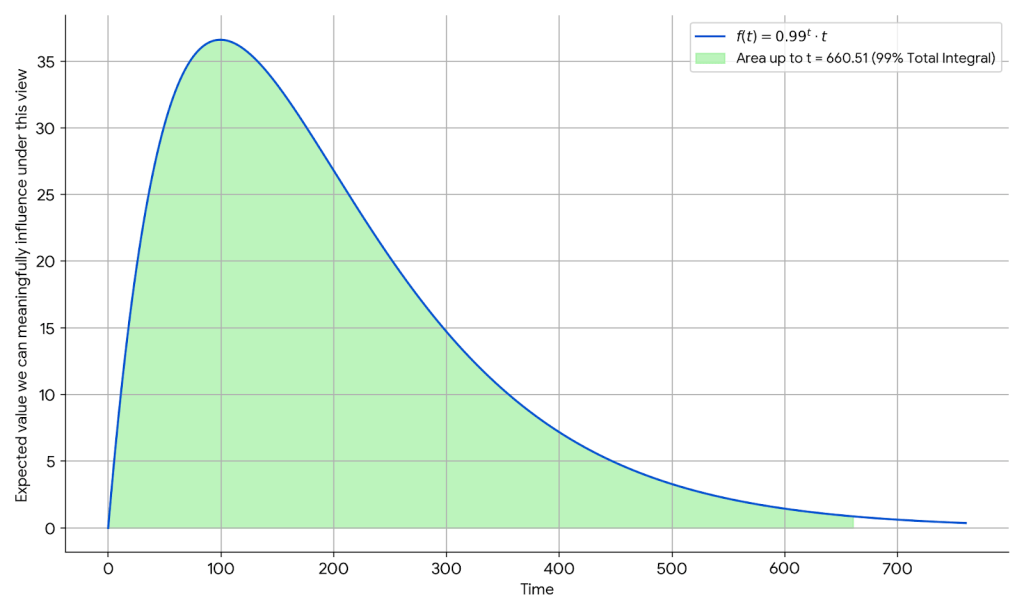
The (Non-)Problem of Induction

David Hume claimed that it is:

[…] impossible for us to satisfy ourselves by our reason, why we should extend [our experience of cause and effect] beyond those particular instances, which have fallen under our observation. We suppose, but are never able to prove, that there must be a resemblance betwixt those objects, of which we have had experience, and those which lie beyond the reach of our discovery.

This gives rise to the problem of induction: how can we defend assuming the so-called uniformity of nature that we take to exist when we generalize our limited experience to that which lies “beyond the reach of our discovery”? For instance, how can we justify our belief that the world of tomorrow will, at least in many ways, resemble the world of yesterday? Indeed, how can we justify believing that there will be a tomorrow at all?

A point worth highlighting in response to this problem is that, even if we were to assume that we have no justification for believing in such uniformity of nature, this would not imply that we thereby have justification for believing the opposite: that there is no uniformity of nature. After all, to positively state that the patterns we have observed so far do not predict anything about states and events elsewhere would also amount to a claim about that which lies “beyond the reach of our discovery”, and so this claim seems to face the same problem.

The claims 1) “there is (some degree of) uniformity throughout nature” and 2) “there is no uniformity throughout nature” are both hypotheses about the world. And if we look at the limited part of the world about which we do have some knowledge, it is clear that the former hypothesis is true to a large extent: patterns observed at one point in time and space do indeed predict a lot about patterns observed elsewhere.

Does this then mean that the same will hold true of the part of the world that lies beyond the reach of our discovery? One can reasonably argue that we do not have complete certainty that it will (indeed, one can reasonably argue that we should not have complete certainty about any claim our fallible mind happens to entertain). Yet if we reason as scientists — probabilistically, endeavoring to build the picture of the world that seems most plausible in light of all the available evidence — then it does indeed seem justifiable to say that hypothesis 1 seems much more likely to be true of that which lies “beyond the reach of our discovery” than does hypothesis 2. This is not least because hypothesis 2 would imply an extreme uniqueness of the observed compared to the unobserved, whereas hypothesis 1 merely amounts to not assuming such an extreme uniqueness.

If we think in this way — in terms of competing hypotheses to which we assign different levels of plausibility — Hume’s problem of induction no longer seems so compelling or problematic. After all, even if we cannot deductively prove our hypotheses about that which lies beyond our experience, we can still have probabilistic reasons — based on cumulative observations — to consider some hypotheses (much) more likely than others.

The Problem of Induction Relies on Induction

In addition to these points about probabilistic reasons, it is worth noting that one can turn Hume’s skeptical argument on itself. For example, Hume’s argument assumes that there is something that lies “beyond the reach of our discovery”, beyond our known experience. But, in Hume’s spirit, we can ask what justifies this inductive assumption about there being something beyond our known experience. It seems that Hume is here assuming something for which he has no deductive proof. In the very framing of his argument, he is tacitly assuming what he thinks we cannot have satisfying reason to believe. After all, what deductive proof can Hume give for there being anything beyond our known experience?

Relatedly, one can make an argument suggesting that it is impossible to give a coherent argument against (at least some degree of) uniformity in nature. For in order to even raise a doubt or an argument against (some degree of) uniformity in nature, one is bound to rely on the very thing one is trying to question. For example, one must assume that words will still mean the same in the next moment as they did in the previous one, and not least that there will be a next moment to begin with.

Thus, it seems impossible to coherently argue against or doubt at least some degree of uniformity in nature, which itself seems to be a reason to believe in such uniformity. After all, that something cannot be coherently doubted arguably gives us some reason to believe it.

In sum, if one thinks we have good reason to take the problem of induction seriously, or good reason to believe that this problem will persist in the future (since it has in the past), then one also believes that we have good reason to make (at least some) inductive generalizations about that which lies beyond the reach of our discovery.

“The Physical” and Consciousness: One World Conforming to Different Descriptions

My aim in this essay is to briefly explain a crucial aspect of David Pearce‘s physicalist idealist worldview. In particular, I seek to explain how a view can be both “idealist” and “physicalist”, yet still be a “property monist” view.

Pearce himself describes his view in the following way:

“Physicalistic idealism” is the non-materialist physicalist claim that reality is fundamentally experiential and that the natural world is exhaustively described by the equations of physics and their solutions […]

So Pearce’s view is a monist, idealist view: reality is fundamentally experiential. And this reality also conforms to description in physical terms. Pearce is careful, however, to distinguish this view from panpsychism, which Pearce, in contrast to his own idealist view, considers a property dualist view:

“Panpsychism” is the doctrine that the world’s fundamental physical stuff also has primitive experiential properties. Unlike the physicalistic idealism explored here, panpsychism doesn’t claim that the world’s fundamental physical stuff is experiential. Panpsychism is best treated as a form of property-dualism.

How, one may wonder, is Pearce’s view different from panpsychism, and from property dualist views more generally? This is something I myself have struggled a lot to understand, and inquired him about repeatedly. And my understanding is the following: according to Pearce, there is only consciousness, and its dynamics conform to physical description. Property dualist views, in contrast, view the world as having two properties: the stuff of the world has insentient physical properties to which separate, experiential properties are somehow attached.

Pearce’s view makes no such division. Instead, on Pearce’s view, description in physical terms merely constitutes a particular (phenomenal) mode of description that (phenomenal) reality conforms to. So to the extent there is a dualism here, it is epistemological, not ontological.

The Many Properties of Your Right Ear

For an analogy that might help explain this point better, consider your right ear. What properties does it have? Setting aside the question concerning its intrinsic nature, it is clear that you can model it in various ways. One way is to touch it with your fingers, whereby you model it via your faculties of tactile sensation (or in neuroanatomical terms: with neurons in your parietal lobe). You may also represent your ear via auditory sensations, for example, by poking it and noticing what kind of sound it makes (a sensation mediated by the temporal lobe). Another way, perhaps the clearest and most practical way for beings like us, is to model it in terms of visual experience: to look at your right ear in the mirror, or perhaps simply imagine it, and thereby have a visual sensation that represents it (mediated by the occipital lobe).

(For most of us, these different forms of modeling are almost impossible to keep separate, as our touching our ears automatically induces a visual model of them as well, and vice versa: a visual model of an ear will often be accompanied by a sense of what it would be like to touch it. Yet one can in fact come a surprisingly long way toward being able to “unbind” these sensations with a bit of practice. This meditation and this one both provide a good exercise in detaching one’s tactile sense of one’s hands from one’s visual model of them. This one goes even further, as it climaxes with a near-total dissolution of our automatic binding of different modes of experience into an ordered whole.)

Now, we may ask: which of these modes of modeling constitute the modeling we call “physical”? And the answer is arguably all of them, as they all relate to the manifestly external (“physical”) world. This is unlike, say, things that are manifestly internal, such as emotions and thoughts, which we do not tend to consider “physical” in this same way, although all our sensations are, of course, equally internal to our mind-brain.

“The physical” is in many ways a poorly defined folk term, and physics itself is not exempt from this ambiguity. For instance, what phenomenal mode does the field of physics draw upon? Well, it is certainly more than just the phenomenology of equations (to the extent this can be considered a separate mode of experience). It also, in close connection with how most of us think about equations, draws heavily on visuospatial modes of experience (I once carefully went through a physics textbook that covered virtually all of undergraduate level physics with the explicit purpose of checking whether it all conformed to such description, and I found that it did). And we can, of course, also describe your right ear in “physics” terms, such as by measuring and representing its temperature, its spatial coordinates, its topology, etc. This would give us even more models of your right ear.

Different phenomenological models of the same thing

The deeper point here is that the same thing can conform to description in different terms, and the existence of such a multitude of valid descriptions does not imply that the thing described itself has a multitude of intrinsic properties. In fact, none of the modes of modeling an ear mentioned above say anything about the intrinsic properties of the ear; they only relate to its reflection, in the broadest sense.

And this is where some people will object: why believe in any intrinsic properties? Indeed, why believe in anything but the physical, “reflective”, (purportedly) non-phenomenal properties described above?

To me, as well as to David Pearce (and Galen Strawson and many others), this latter claim is self-undermining and senseless, like a person reading from a book who claims that the paper of the book they are reading from does not exist, only the text does. All these modes of modeling mentioned above, including all that we deem knowledge of “the physical”, are phenomenal. The science we call “physics” is itself, to the extent it is known by anyone, found in consciousness. It is a particular mode of phenomenal modeling of the world, and thus to deny the existence of the phenomenal is also to deny the existence of our knowledge of “physics”.

Indeed, our knowledge of physics and “the physical” attests to this fact as clearly as it attests to anything: consciousness exists. It is a separate question, then, exactly how the varieties of conscious experience relate to descriptions of the world in physical terms, as well as what the intrinsic nature of the stuff of the world is, to the extent it has any. Yet by all appearances, it seems that minds such as our own conform to physical description in terms of what we recognize as brains, and, as with the example of your right ear, such a physical description can take many forms: a visual representation of a mind-brain, what it is like to touch a mind-brain, the number of neurons it has, its temperature, etc.

These are different, yet valid ways of describing aspects of our mind-brains. Yet like the descriptions of different aspects of an ear mentioned above, these “physical” descriptions, while all perfectly valid, still do not tell us anything about the intrinsic nature of the mind-brain. And according to David Pearce, the intrinsic nature of that which we (validly) describe in physical terms as “your brain” is your conscious mind itself. The apparent multitude of aspects of that which we recognize as “brains” and “ears” are just different modes of conscious modeling of an intrinsically monist, i.e. experiential, reality.


The view of consciousness explored here may seem counter-intuitive, yet I have argued elsewhere that using waves as a metaphor can help render it less unintuitive, perhaps even positively intuitive.

Blog at WordPress.com.

Up ↑